

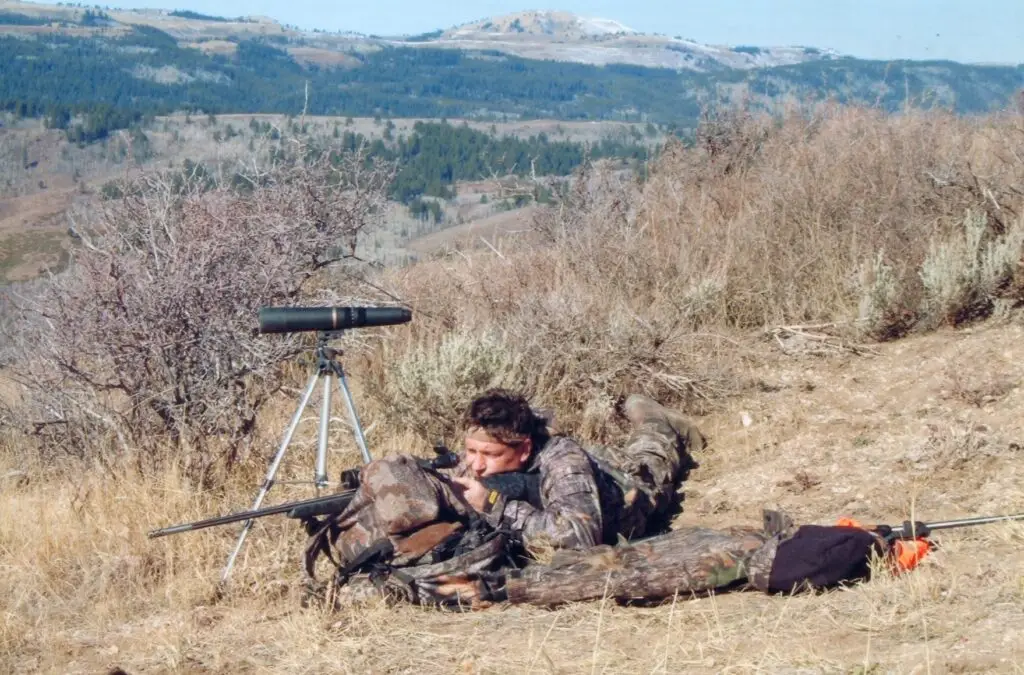
There are several big game hunting methods that hunters use. Choosing the right hunting method depends on the species being hunted, terrain, weather, and amount of hunting pressure. Matching your strategy to these shifting conditions helps you adapt in the field and improves your overall success.
Blind or Tree Stand Hunting
Ambush hunting is a passive hunting style that requires the most pre-hunt preparation. The core objective is to remain concealed while waiting for game to move within range. Hunters achieve this by utilizing elevated tree stands, commercial popup blinds, or custom ground blinds built from local, natural vegetation. To maximize success, scout early and position your setup near food or water, or directly between known bedding areas and seasonal food or water sources.
If you plan to hunt the same site many times over the course of a season, your placement should have concealed access to and from your stand site. If you spook wary, mature animals, such as whitetail deer, axis deer, or aoudad sheep on your approach or exit, you probably won’t see them in the area again for quite some time, and perhaps the rest of the hunting season.
Consistently successful hunters usually take extreme caution concealing their stands, cutting shooting lanes, silencing their stands and equipment, and hunting only when the wind and weather is in their favor.
Custom stand setups run the gamut from a few boards nailed in a tree to elaborate carpeted blinds equipped with electricity, a TV, and a bathroom. Whitetail deer and some exotic species are often hunted from these blinds..
This is a good method to use if neighboring properties are experiencing a lot of hunting pressure, or you only have a small parcel to hunt.
Safari Style Hunting
Safari style hunting involves using some sort of motorized vehicle or boat to search for game. Once a suitable animal is spotted, it can either be harvested from the vehicle or a short stalk can be attempted. This type of hunting is often used to hunt plains game on an African safari. In Africa, these hunts are often done from an open back Toyota Land Cruiser or similar jeep-like vehicle. For exotic hunting in the USA and other places, a side-by-side is most often used.
Safari-style hunting allows hunters to cover a lot of ground quickly by using vehicles to spot game. This method is also much less physically demanding than the spot-and-stalk techniques. Additionally, having transport nearby simplifies the process of retrieving and hauling heavy harvested game.
Spot and Stalk Hunting
Spot and Stalk hunting is almost always the most physically demanding method of hunting. This involves glassing or spotting game in the distance and then attempting a stalk to get within shooting distance. This is a very rewarding form of hunting, but you need to honestly evaluate your physical abilities and the potential issues you might encounter before planning this type of hunt.
Spot and stalk hunting is often done in hilly or mountainous country. The terrain is frequently beautiful, daunting, and potentially overwhelming. The concept is to spot game from a vantage point before it sees you, and then carefully plan to close the distance so you can confidently take a killing shot.
Here is a partial list of challenges you may encounter with a spot and stalk hunt:
- You are not physically able to hike and climb after your intended game. Mountains are steep and the air can be thin.
- The game moves before you can get to where the animals were spotted.
- After finding a suitable animal, you run out of time to get to the animal before nightfall.
- You encounter an obstacle, such as a river, lake, or cliffs between you and the animal that you didn’t anticipate when planning your stalk.
- You can’t determine the trophy size from your vantage point. Quality spotting scopes help a lot.
- You startle other animals on your stalk that in turn scare your intended target away.
- The vegetation is much taller or thicker than anticipated so you can’t find the game even if you’re confident you are in the correct location.
- You get lost while focusing on the game.
This form of hunting is common in the western United States, Canada, Alaska, and the mountains of Asia, Europe, New Zealand, and Argentina. Elk, mule deer, red stag, moose, sheep, goats, ibex, and urials are most commonly hunted with the spot and stalk method.
Still Hunting
Still hunting is the most mentally exhausting strategy in the field. It is highly effective in thick cover, provided all the conditions align. Success requires total certainty that game frequents the area, a highly favorable wind, and quiet ground cover that masks your movement. Still hunting is not wandering around in the woods, it is a calculated process where every single step is planned to avoid snapping twigs or crunching leaves. A hunter should spend the majority of their time standing still and intensely scanning the visible terrain before committing to their next move.
I often use a small pair of binoculars to look at things that could potentially be an animal. I personally only use still hunting if the weather is windy, raining, or snowing. I also must be certain that I will not be interfering with other hunters. Just remember it’s still hunting, not walking hunting.
Driven Hunt
A driven hunt is where someone or something pushes animals to a pinch-point where posted hunters wait for game to pass by them so they can take a shot in a safe direction. Humans, dogs, vehicles, and even helicopters can be used to drive animals in a desired direction.
Deer drives have been a popular method to hunt whitetail deer in the Eastern and Midwest wooded sections of the United States. It’s also used extensively in Europe for various species of game.
Driven hunts can be an effective way to harvest game animals, and it’s a way for large groups of friends to hunt together.
Calling
Waterfowl and turkey hunters are not the only people that call animals to within shooting range. Big game hunters also use this exciting method to call animals to their location. When calling big game, you need to expect the unexpected, since you can experience some fast action and close encounters. Part of the battle is to choose good locations to call from. It’s best to setup where you don’t expect the game to come to the call from all directions because they often circle down wind and leave before you even knew they were approaching the call.
Some popular calls are grunts, wheezes, snorts, bleats, bugling, and antler rattling. Predators can be called in by using hand-held or electronic distress calls. One of the tricks is to not over-call or call too loud. It doesn’t take long for animals to become “call shy” after a negative experience or two.
Behind Dogs
Another big game hunting method is to use dogs to assist hunters in finding and tracking an animal. Most frequently, a trained pack of hounds use their sense of smell to track game until it is treed or otherwise cornered. The hunter then catches up to the prey and harvests it. Animal tracks are usually found, and evaluated for size, before the hounds are released to track the animal.
Mountain lions (cougars) are almost exclusively hunted in this fashion. In some locations bears, wild boar, deer, leopards, and lions are pursued using this technique.
Horseback Hunting
Another popular hunting method is to use horses or mules to access remote areas. This is a common method to hunt mountain areas in western United States and Canada on multiple day hunts. Horses are also used to traverse the mountainous areas of Europe and Asia.
This technique is usually used in combination with spot and stalk hunting for elk, mule deer, goats, sheep, and ibex species.
Conclusion
You are very likely to use many of these methods if you plan on hunting a wide range of species, and in many different locations and environments. Big game hunters are very fortunate to have such a large selection of animals to pursue in some of the most beautiful and interesting places in the world.