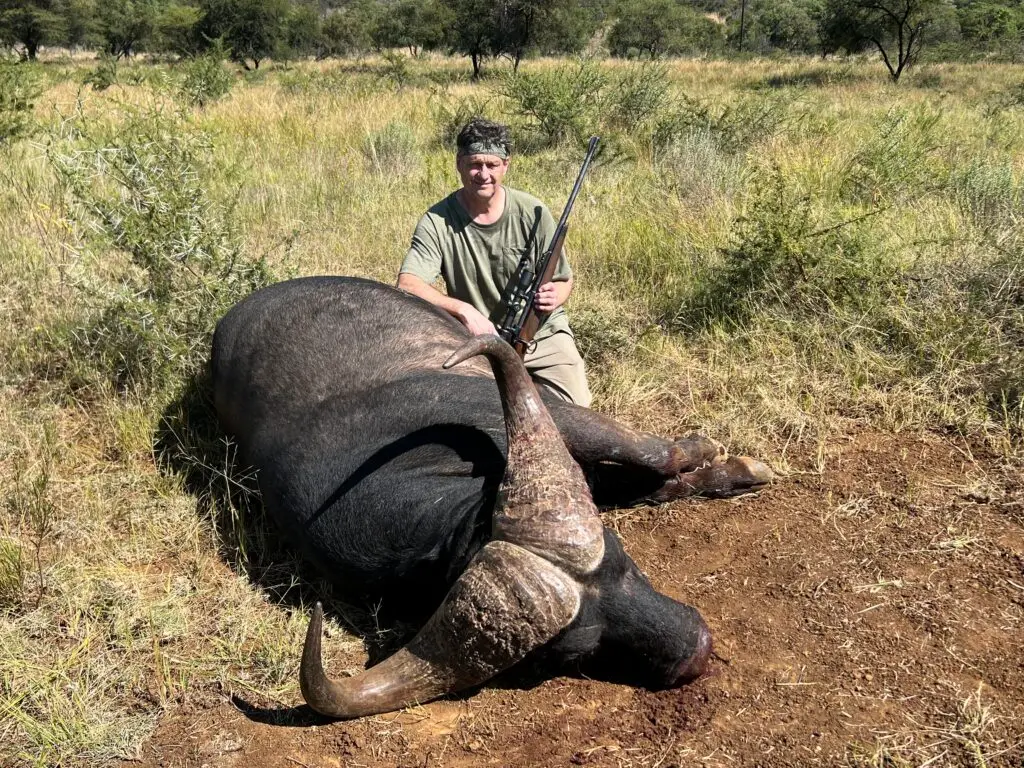

About the Cape Buffalo
Info About the Cape Buffalo
The cape buffalo is a massive, formidable bovine native to sub-Saharan Africa and a celebrated member of the continent’s “Big Five”. Their most defining feature is their heavy, sweeping horns that join in the middle of their heads to form a solid, helmet-like bone shield known as a “boss”.
Renowned for their unpredictable temperament and incredible resilience, cape buffaloes are often called “black death” or “widow-makers” by safari guides and big-game hunters. Though generally docile when grazing, they become fiercely aggressive and dangerous if wounded, cornered, or when protecting vulnerable herd members. They are even known to charge at predators—such as lions—at speeds reaching 35 to 40 mph, and will collectively defend themselves to drive threats away.
These highly social animals live in massive, tightly-knit herds that can number in the hundreds or even thousands. Their grouping provides safety in numbers, with adults acting cooperatively to circle and shield their calves from danger. Older bulls that leave the main herds—often referred to as “dagga boys” from their habit of wallowing in mud—tend to be more solitary and are considered the most cantankerous and unpredictable of the bunch.
Beyond their physical power, cape buffaloes are vital “ecosystem engineers” of the African savanna. As bulk grazers, their feeding habits and constant trampling help convert long, coarse grasslands into shorter environments that support a wider variety of browsing and grazing species. Furthermore, their movements and wallowing behaviors disperse seeds and create new micro-habitats for a multitude of other wildlife.
Description of the Cape Buffalo
- Size & Weight: Adults stand from 4 to 5.6 feet tall at the shoulder and measure from 7 to 11 feet in body length. They weigh from 930 and 2,000 pounds, with bulls outweighing cows by over 200 pounds.
- Coat & Color: Fur is thin but appears shaggy, ranging from dark brown to black. Calves are usually born with reddish-brown coats. Older adults may lose patches of hair.
- Horns: Both sexes have large, curved horns, but males possess an enlarged fused base at the center of their skull (the boss) used for defense and sparring. The distance between horn tips can exceed 3 feet.
- Build: They have a heavy-set body with a disproportionately large, low-hanging head and a short neck, making their front heavier than their back.
- Face: They feature wide-set dark eyes, wide nostrils, and a wet, hairless muzzle (similar to domestic cattle).
Recommended Calibers
Use a minimum of a .375 H&H cartridge rifle to hunt cape buffalo. In most African countries a .375 caliber is the smallest legal cartridge allowed for these members of the big-five.
Where to Hunt Cape Buffalo
Cape buffalo can be hunted in South Africa, Zimbabwe, Zambia, Mozambique, Tanzania, Botswana, and Namibia.
What is Considered a Trophy Cape Buffalo
A cape buffalo trophy size is typically defined by an outside horn spread of 38 inches or larger with hardened boss bones. A spread of 42 inches or greater is considered an exceptional trophy.
Cost to Hunt Cape Buffalo
A cape buffalo bull hunt costs from $9,000 to $25,000 depending on the country and the size of the horns.
View Our Hunts