
About the Bongo
Info About the Bongo
The bongo is the largest and heaviest forest-dwelling antelope in the world, renowned for its striking appearance and elusive nature. Native to the dense tropical jungles and bamboo forests of Africa, this herbivorous ungulate is highly adapted to life in the shadows.
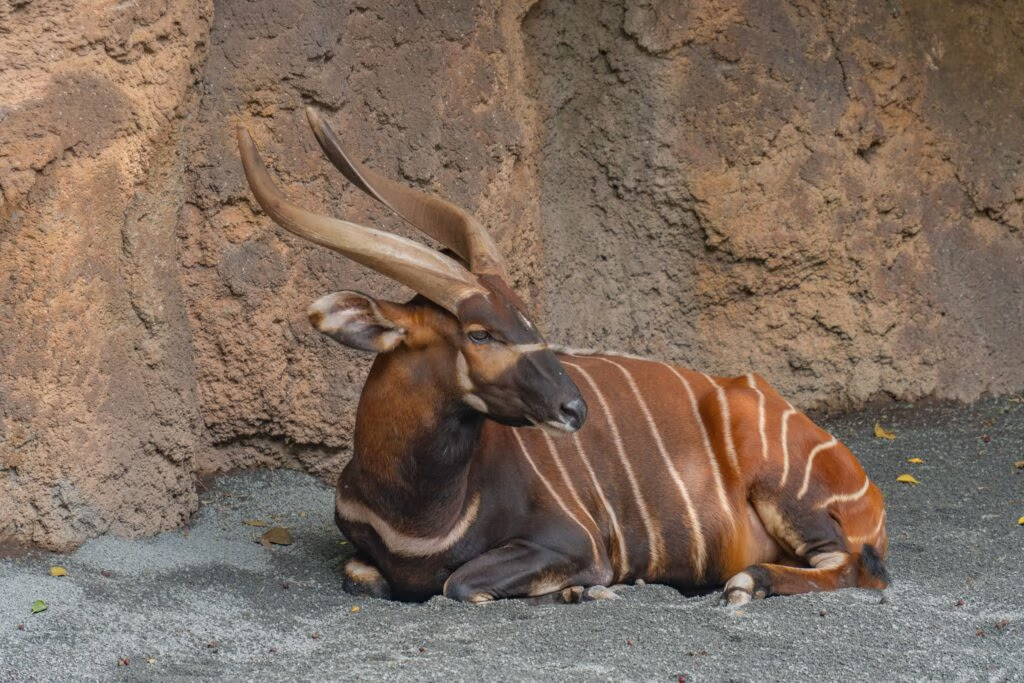
Bongos are easily recognized by their vibrant, chestnut-red coats, which are overlaid with 10 to 15 vertical, whitish-yellow stripes. These markings act as highly effective camouflage, breaking up the animal’s silhouette in the dappled sunlight of the forest. Uniquely, both males and females possess long, slightly spiraled horns that sweep backward over their shoulders. When running through dense brush, bongos tilt their heads back so their horns rest flat against their backs, preventing them from tangling in the vines and branches.
As primarily nocturnal browsers, bongos spend their time foraging for leaves, twigs, vines, and fruits. They use their long, prehensile tongues to strip vegetation and can even stand on their hind legs to reach food high up in the canopy. These social animals generally live in small herds made up of females and their young, while mature males tend to lead solitary lives. Today, both wild populations face severe threats from habitat fragmentation, disease, and illegal hunting.
Description of the Bongo
Key Physical Characteristics
- Size: Bongos measure between 5.5 to 10 feet in length and stand from 3.5 to 4.3 feet tall at the shoulders.
- Weight: Strong sexual dimorphism exists. Females typically weigh from 460 to 557 pounds, while larger males can weigh from 528 to 891 pounds.
- Coat & Markings: Both sexes have a short, glossy reddish-brown to chestnut coat. As males age, their coats darken into a deep mahogany or brownish-black.
- Striation & Facial Markings: Between 10 and 15 vivid vertical white-yellow stripes run down their sides for camouflage. They feature a distinct white chevron (V-shape) between their eyes, white cheek spots, and a white crescent across the chest.
- Horns: Unlike most antelopes, both males and females possess heavy, spiraled keratin horns. They sweep backward and usually have one to one-and-a-half twists, reaching lengths from 30 to 38 inches long.
- Anatomical Features: They have large, broad ears designed for sharp hearing, a thin mane that runs from their shoulders to their rump, and a long tail ending in a tufted tip. They also have long, prehensile tongues used to grasp and strip vegetation.
Bongo Species / Subspecies
There are two distinct subspecies: the lowland (or western) bongo and the critically endangered mountain (or eastern) bongo.
Recommended Calibers
A .30 caliber magnum is the smallest cartridge used to hunt bongo. Cartridges chambered in the .338 and .375 are better choices because of their body size and the dense cover they live in.
Where to Hunt Bongo
Bongos can be hunted free-range in Cameroon and the Central African Republic (CAR).
They can be hunted on numerous high-fence hunting preserves in Texas.
What is Considered a Trophy Bongo
A trophy bongo will have horns measuring from 30 to 40 inches long.
Cost to Hunt Bongo
- An African bongo hunt will cost from $35,000 to over $70,000 depending on the country and outfitter.
- A Texas bongo hunt will cost from $38,000 to $60,000 depending on the size of the horns, and the ranch you hunt.
View Our Hunts