
About the Warthog
Info About the Warthog
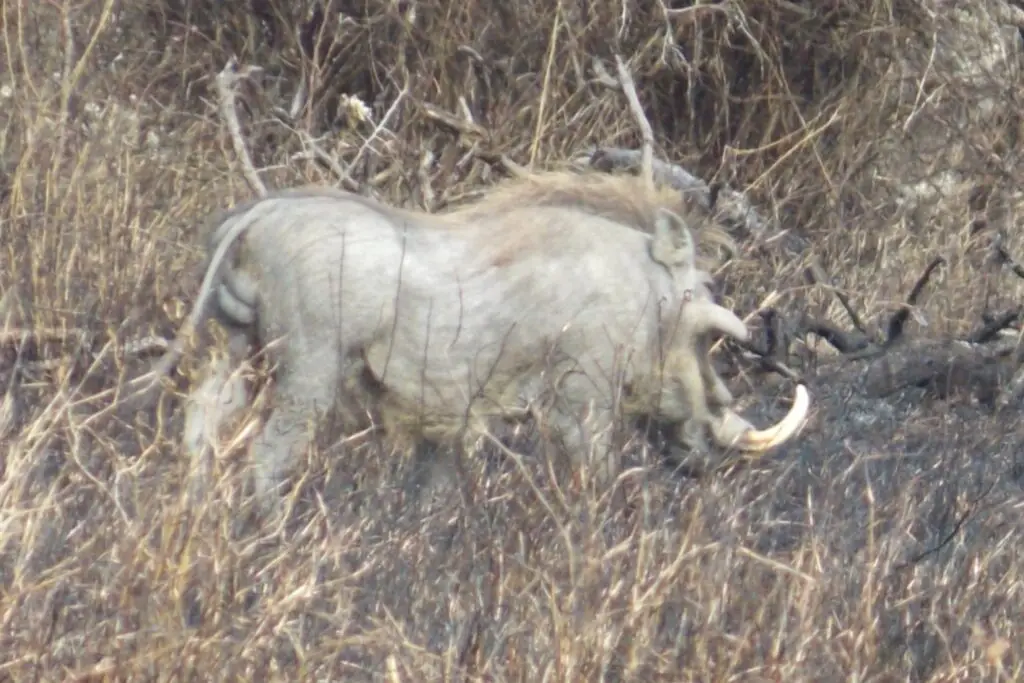
Warthogs are robust, highly adaptable wild pigs found primarily in the savannas, grasslands, and woodlands of sub-Saharan Africa. Easily recognized by their disproportionately large, flat heads, these animals sport distinctive facial “warts” (thick protective pads of skin and cartilage) and curved, ivory-like tusks that can grow up to 2 feet long in older males.
Despite their somewhat fearsome appearance and status as distant relatives to domestic pigs, warthogs are primarily grazers that subsist on grasses, roots, bulbs, and berries. While foraging, they have the peculiar, easily recognizable habit of dropping onto their padded front “knees” to get their snouts closer to the ground. They are also prolific diggers and will use both their snouts and tusks to excavate nutrient-rich tubers, especially during the dry season when water is scarce.
Socially, warthogs exhibit distinct behaviors depending on their age and sex. Females and their young live in small, communal family groups known as “sounders,” while mature males tend to lead solitary lives or gather in small bachelor groups. To escape the scorching sun and avoid predators like lions, leopards, and hyenas, warthogs frequently wallow in mud and seek shelter in underground burrows, often stealing or inheriting dens previously abandoned by aardvarks. Rather than engaging in direct fights with predators, they are surprisingly fast sprinters capable of reaching speeds up to 30 mph, characteristically running with their long, tufted tails held entirely upright.
Description of the Warthog
- Facial “Warts”: Their defining feature is the three pairs of thick, fleshy, hair-covered bumps on their face. These are actually protective pads of connective tissue and fat, not true warts. Males have significantly larger warts than females.
- Distinct Tusks: Both sexes have two pairs of sweeping tusks that emerge from their canines. The upper tusks grow outward and upward in a semicircle (up to 25 inches in males), while the lower tusks are shorter, flat, and razor-sharp.
- Body & Size: They measure roughly from 36 to 60 inches in length and stand about 24 to 30 inches tall at the shoulders. Males are notably heavier, ranging from 130 to 330 pounds, while females weigh from 110 to 165 pounds.
Recommended Calibers
Use a minimum of a 6.5mm caliber rifle to hunt warthogs.
Where to Hunt Warthog
The following African countries have good warthog hunting: Namibia, South Africa, Botswana, Zimbabwe, Tanzania, Mozambique, and Ethiopia.
There are a few high-fenced hunting preserves in Texas where warthogs are hunted.
What is Considered a Trophy Warthog
A trophy warthog is judged primarily by the length and curvature of its upper tusks measured along the outside curve. A standard or good trophy boar has tusks measuring from 10 to 12 inches long, while exceptional trophies measure 13 inches or more.
Cost to Hunt Warthog
The trophy fee typically costs from $350 to $750 to hunt warthogs when on an African safari.
View Our Hunts