
About the Blue Sheep
Info About the Blue Sheep
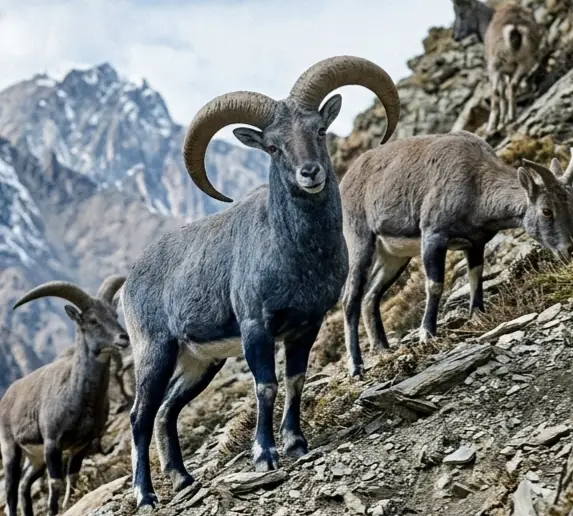
The blue sheep, widely known as the bharal, is a remarkable mountain ungulate native to the high Himalayas and the Tibetan Plateau. Despite its common name, the blue sheep is neither a true sheep nor is it bright blue; it is actually a caprine closely related to goats. Its coat is typically a slate-gray or brownish-gray color with a subtle bluish tint, which provides near-perfect camouflage against the rocky, alpine landscapes it calls home.
These sure-footed herbivores thrive at staggering elevations, often ranging from 8,000 to 20,000 feet above sea level. They live on treeless alpine meadows and steep, precipitous cliffs. Because their environment lacks natural cover, blue sheep rely heavily on their unique defense mechanism: when approached or threatened by predators like snow leopards or Himalayan wolves, they remain completely motionless, allowing their coloration to blend seamlessly with the blue-gray rock face. If discovered, they use their incredible agility to scamper up the steepest, most treacherous cliffs to safety.
Blue sheep exhibit significant sexual dimorphism, meaning the males and females look quite different. Adult males are robust, and sport magnificent, backward-sweeping horns that curve out like an upside-down mustache. Females are considerably smaller and possess much shorter, straighter horns. As primarily grazing animals, their diet shifts with the seasons; they consume fresh alpine grasses during the summer and resort to mosses, lichens, and hardy shrubs during the freezing, harsh winters.
Description of the Blue Sheep
- Size and Build: Stocky and muscular with stout, agile legs built for steep, rocky inclines. They stand about from 2.5 to 3 feet at the shoulders.
- Weight: Sexual dimorphism is highly pronounced. Males (rams) weigh from 132 to 165 pounds, while females (ewes) weigh from 77 to 99 pounds.
- Coat and Coloration: The dense fur ranges from slate-grey to bluish-grey, though summer coats can appear brownish-grey. The chest, the front of the legs, and a distinctive lateral stripe separating the flanks from the belly are solid black. The face also features a dark mask. The belly, rump, and inner legs are bright white.
- Horns: Both sexes possess horns, but they differ significantly:
- Males have large, heavy horns that curve upward and outward, then loop backward (resembling an upside-down mustache). They can grow from 30 to 32 inches in length.
- Females have much smaller, straighter, and un-ridged horns that grow vertically, usually reaching only up to 6 to 8 inches.
- Face and Tail: They have long ears, a pinkish triangle-shaped nose, and a short tail (4 to 8 inches) that is black-tipped. They lack the beard typical of true goats.
Blue Sheep Species / Subspecies
Himalayan Blue Sheep
- Habitat & Range: Native to the high Himalayas of Nepal, India, Bhutan, and parts of Tibet, Pakistan, and western China. They inhabit extremely steep, alpine meadows and rocky slopes.
- Physical Traits: This subspecies generally has larger horns than the Chinese blue sheep and features a thicker black lateral stripe that runs along the flanks and connects to a dark chest patch.
Chinese Blue Sheep
- Habitat & Range: Distributed across central and northern China (including Qinghai, Gansu, Sichuan, and Ningxia provinces) with their western range extending into Tibet.
- Physical Traits: These sheep feature lighter, less distinct black markings on the chest and face, and their horns tend to be slightly smaller than those of their Himalayan counterparts.
Helan Shan Blue Sheep
- Habitat & Range: This is a distinct, isolated population found primarily in the Helan Mountains of the Ningxia and Inner Mongolia regions of China.
- Physical Traits: Molecular genetic studies highlight this group as having a distinct evolutionary lineage compared to other Chinese populations.
Dwarf Blue Sheep
- Habitat & Range: Found at relatively lower elevations (8,500 to 10,500 feet) in the rugged, arid gorges of the upper Yangtze River in Sichuan and Tibet.
Recommended Calibers
Use a minimum of a 6.5mm caliber rifle to hunt blue sheep.
Where to Hunt Blue Sheep
Blue sheep can be hunted free range in Nepal and Pakistan.
Texas offers high fence hunting preserve hunts on numerous ranches.
What is Considered a Trophy Blue Sheep
A good blue sheep trophy is widely defined by its horn length and mass. A mature trophy ram typically features heavy bases, and a pronounced outward and backward curve.
- Average trophy: Horns measuring between 22 to 25 inches
- Exceptional trophy: Horns measuring between 25 to 28 inches
- World-class trophy: Horns measuring between 28 to 30 inches and beyond
Cost to Hunt Blue Sheep
- In Nepal, a blue sheep hunt costs between $16,000 and $31,000.
- In Pakistan, a blue sheep hunt costs between $24,000 and $55,000.
- In Texas, a blue sheep hunt costs $24,000 and up depending on the size of the horns.
View Our Hunts