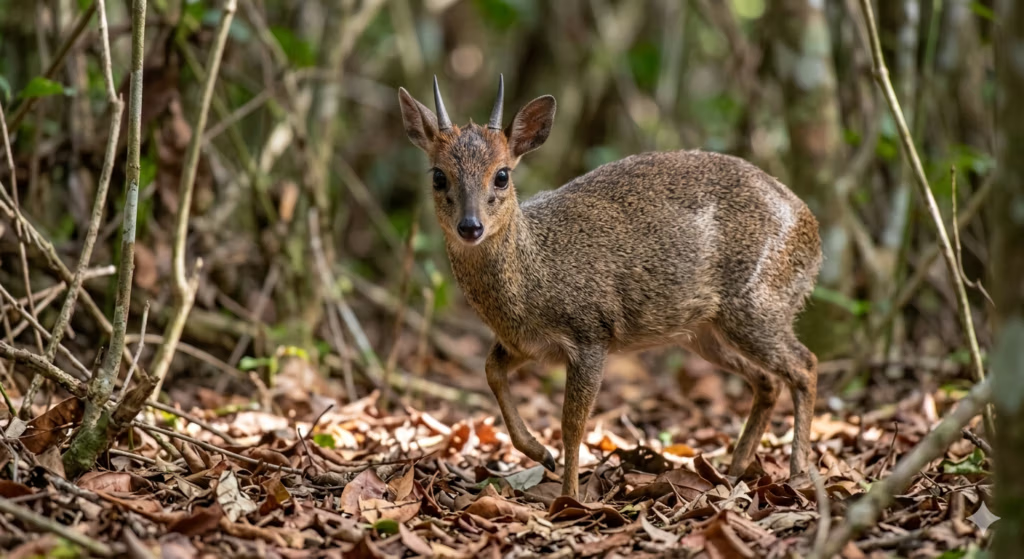

About the Suni
Info About the Suni
The suni is a tiny, shy antelope native to the dense thickets and coastal forests of eastern and southern Africa. Standing only from 13 to 15 inches tall at the shoulders and weighing roughly 10 pounds, these diminutive herbivores rely on their cryptic reddish-brown coats to blend seamlessly into the forest understory.
Because they are incredibly selective foragers, sunis rarely graze on grass; instead, they spend their time browsing for fallen leaves, flowers, fungi, and fruit. They are known to shadow monkeys and birds in the canopy, picking up the scraps dropped from above. Sunis are also highly adapted to arid conditions and can survive long periods without drinking free water, getting all the moisture they need from their diet.
Sunis are secretive and primarily nocturnal or active during twilight, preferring to sleep in shaded cover during the heat of the day. When threatened by predators, they employ a brilliant defense mechanism: they freeze to blend in with the leaf litter, only darting away at the very last second in an erratic zigzag pattern. Currently listed as a species of Least Concern globally by the IUCN, local populations—particularly in South Africa’s ancient sand forests—are classified as vulnerable due to habitat loss and fragmentation.
Description of the Suni Antelope
A detailed breakdown of the suni’s physical traits includes:
Coat & Coloration
- Upperparts: Rich reddish-brown to chestnut with a slight grayish, speckled appearance. The back is noticeably darker than the sides and legs.
- Underparts: White fur covers the chin, throat, chest, belly, and the insides of the legs.
- Tail: Short and dark brown or black on the top, with a white underside that is frequently flicked.
Head & Face
- Ears: Broad, rounded, naked, and pinkish on the inside, with ashy-grey on the outside and white hairs along the upper inner margin.
- Eyes: Encircled by distinct pale rings of nearly bare skin, with prominent stiff hairs positioned above them.
- Nostrils: Noticeably red.
- Glands: Features extremely large preorbital scent glands (relative to its body size) located in front of the eyes, which produce a pungent, musky secretion used to mark territory.
Horns & Legs
- Horns: Only the males (rams) possess horns. They are from 2 to 5 inches long, black, heavily ridged, and slope backward in line with the face.
- Legs & Hooves: Long and slender with dark feet. A distinctive black band or ring encircles the leg just above the hooves, which are small, glossy, and black.
Suni Antelope Species / Subspecies
- Coastal Suni: Found on the Zanzibar Archipelago (such as Unguja and Changuu islands) and the coastline of Kenya.
- Livingstone’s Suni: Found in southern Malawi, inland Mozambique, Zimbabwe, and KwaZulu-Natal, South Africa.
- Mountain Suni: Inhabits the highlands and coastal regions of Kenya (including Mount Kenya and the Aberdare Range) and extends into northeastern Tanzania.
- Southern Suni: Found in Eswatini, southern Mozambique, and northeastern South Africa.
- Kikuyu Suni: Recognized in some classifications, this subspecies is native to the central Kenya highlands.
Recommended Calibers
The ideal rifle to hunt a suni is a flat-shooting, small-bore centerfire, such as a .223 Remington, .22 Hornet, or .243 Winchester, loaded with 45 to 55-grain non-expanding monolithic solid bullets.
Another popular option, is to use a 12-gauge or 20-gauge loaded with small birdshot (e.g., #5, #6, or #7) . It provides an excellent pattern for snap-shooting in thick brush at very close ranges (15 to 30 yards), anchoring the animal immediately without large exit wounds.
Where to Hunt Suni
Sunis are hunted in Mozambique, South Africa, and Tanzania.
What is Considered a Trophy Suni
A trophy suni will have horns measuring at least 3 inches long.
Cost to Hunt Suni
The trophy fee to hunt suni is from $300 to $4,000 depending on the country and outfitter you hunt with.