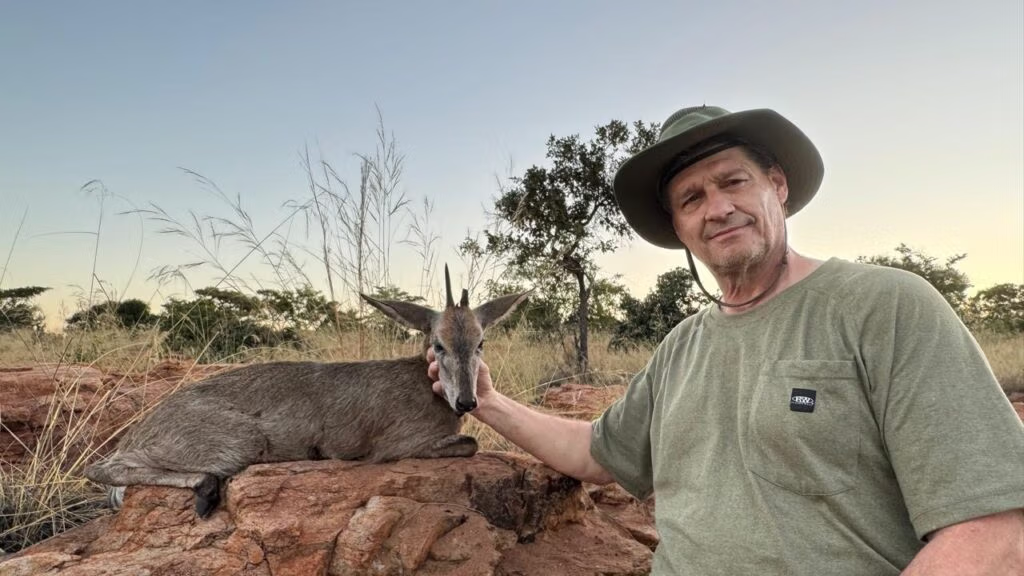

A duiker is a small to medium-sized, secretive antelope native to sub-Saharan Africa. They get their name from the Afrikaans and Dutch word meaning “to dive”, which perfectly describes their behavior of instantly diving into dense underbrush for cover when startled. They are primarily browsing animals adapted for life in heavily wooded areas, rainforests, and bushlands.
Physically, duikers have evolved for easy movement through thick vegetation. Most species feature low-slung bodies, slender legs, and arched backs. Size varies drastically across the approximately 22 species. For instance, the tiny blue duiker weighs only from 9 to 12 pounds, while the largest, the yellow-backed duiker, can weigh over 150 pounds. Most duikers have distinct wedge-shaped heads topped with a small crest of hair and possess large, expressive eyes and scent glands beneath their eyes.
Diet-wise, duikers are opportunistic herbivores, though they are considered some of the most omnivorous of all antelopes. They mostly browse on leaves, fruits, and seeds that fall from the forest canopy, but they have also been known to consume insects, nestling birds, and even small vertebrates. Because of their need for dense cover and high-quality browse, they generally live alone or in strictly monogamous pairs, vigorously defending their small territories using vocalizations and scent-marking behaviors.
Description of the Duiker
- Size: Highly variable depending on the species. The smallest, the blue duiker, is cat-sized (about 12 inches tall, weighing from 8 to 20 pounds.), while the yellow-backed duiker can weigh up to 176 pounds and stand around 30 inches tall at the shoulders.
- Legs: Thin and short, often with darker lower legs that give the appearance of wearing “high stockings”.
- Horns: Most species have short, backward-pointing, unbranched spike horns. In many species, both males and females have them, though females’ are generally smaller.
- Head & Face: They have wedge-shaped heads with uniquely large scent glands (preorbital glands) located just below the eyes on the snout. These form visible bulges and are used to mark territory.
- Hair Crest: A characteristic tuft of hair, often called a “mohawk” or crest, is usually present between their horns.
- Coloration: Coat color varies widely to blend into their specific habitats (cryptic coloration), ranging from uniform gray, reddish-brown, and blue-gray to boldly striped.
Duiker Species / Subspecies
Duikers can be organized into the following 3 categories, though there are around 22 subspecies:
- Forest Duikers: This is the largest group, containing around 15 species (such as the Red Duiker, Zebra Duiker, and the Yellow-backed Duiker).
- Blue Duikers: These include 2 to 3 species of tiny, dwarf antelopes, with the Blue Duiker being the smallest.
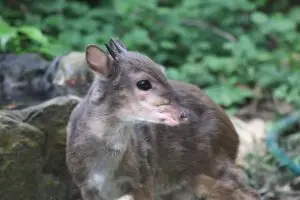
- Bush or Common Duikers: This group contains only one recognized species (Common, also called the Grey Duiker), which uniquely adapts to savannas rather than dense forests.