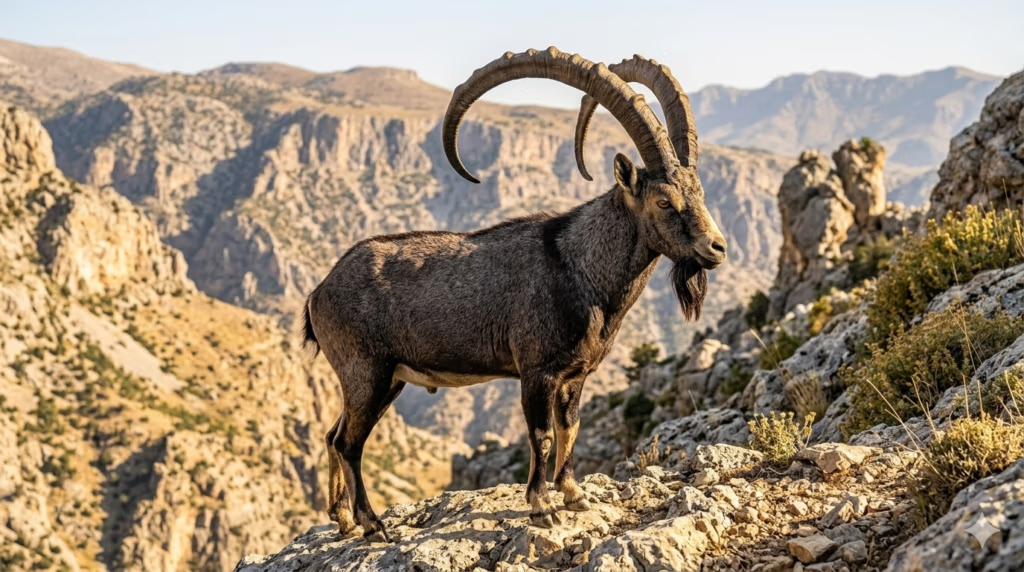

The ibex is a legendary genus of wild mountain goat (Capra) known for its breathtaking agility and survival in some of the most extreme, rugged terrains on Earth. Famous for their thick coats and incredible climbing abilities, ibex are found across high-altitude mountain ranges and rocky deserts in Europe, Asia, and North Africa.
These animals are uniquely adapted to vertical, unforgiving landscapes. Their specially designed hooves feature hard outer rims and soft, rubber-like inner pads, providing a natural grip that allows them to scale near-vertical cliff faces and leap across narrow rock ledges without slipping. During the summer, ibex frequently climb to high elevations near the snow line to graze on grasses and moss. As winter approaches, they migrate down to lower, south-facing slopes where snow is less deep and food remains more accessible.
One of the most striking physical features of the ibex is its massive, sweeping horns, which are heavily ridged and can grow up to 36 inches in length or more. While females possess smaller, thinner horns, the males carry heavy, backward-curving horns that they use for dominance displays and fierce clashing battles during the autumn breeding season, known as the rut. Thanks to successful conservation and reintroduction programs—such as those that saved the Alpine Ibex—these resilient mountain dwellers remain a remarkable symbol of wild, untamed environments.
Description of the Ibex
Overall Dimensions
- Shoulder Height: from 26 to 41 inches in height at the shoulders.
- Body Length: from 47 to 71 inches in body length.
- Weight (Males): from 132 to 308 pounds.
- Weight (Females): from 55 to 132 pounds.
Key Physical Features
- Horns: The most iconic trait. Both sexes have horns, but males feature massive, heavy, backward-curving horns adorned with distinct ridges that can grow from 39 to 59 inches long. Female horns are much smaller and thinner.
- Body Shape: Robust and muscular, with a stocky torso, strong legs, and a low center of gravity for navigating rough terrain.
- Coat: Typically a mix of brown, gray, and yellowish tones, often with lighter underparts and darker legs. The coat undergoes seasonal changes: short and smooth in the summer, and long and wooly with dense underfur during winter.
- Facial Features: Typically feature a distinct beard on the chin, large ears, and excellent eyesight with horizontal pupils for spotting predators across vast landscape.
Ibex Species / Subspecies
1. Spanish Ibex
- Southeastern Spanish Ibex: Found primarily in the Sierra Nevada and southern coastal regions of Spain. They are smaller and lighter in color with impressive backward-curving horns.
- Gredos Ibex / Western Spanish: Famous for their large lyre-shaped horns. They reside primarily in central Spain’s Sierra de Gredos mountain range.
- Beceite Ibex: Second largest Spanish Ibex lives in the Beceite mountains.
- Ronda Ibex: The smallest Spanish Ibex lives in the small mountain area in the Malaga province.
2. Siberian Ibex
- Altai Ibex: Native to the Sayan and Altai Mountains in Central Asia.
- Tian Shan Ibex: Found primarily in the Tian Shan and Alay mountain systems.
- Gobi / Mongolian Ibex: Inhabits the rugged desert and mountainous terrain of western Mongolia.
- Himalayan Ibex: Found across the high-altitude Pamir and western Himalayan ranges in India, Pakistan, and Afghanistan.
3. Nubian Ibex
4. Other Distinct Species
- Walia Ibex: Found exclusively in the Simien Mountains of the Ethiopian Highlands. It is sometimes treated as a subspecies of the Alpine Ibex, but is mostly classified on its own.
- Bezoar Ibex: Technically a subspecies of the wild goat, but widely referred to as an ibex. They are native to the forested montane regions of Turkey, the Caucasus, and the Zagros Mountains.