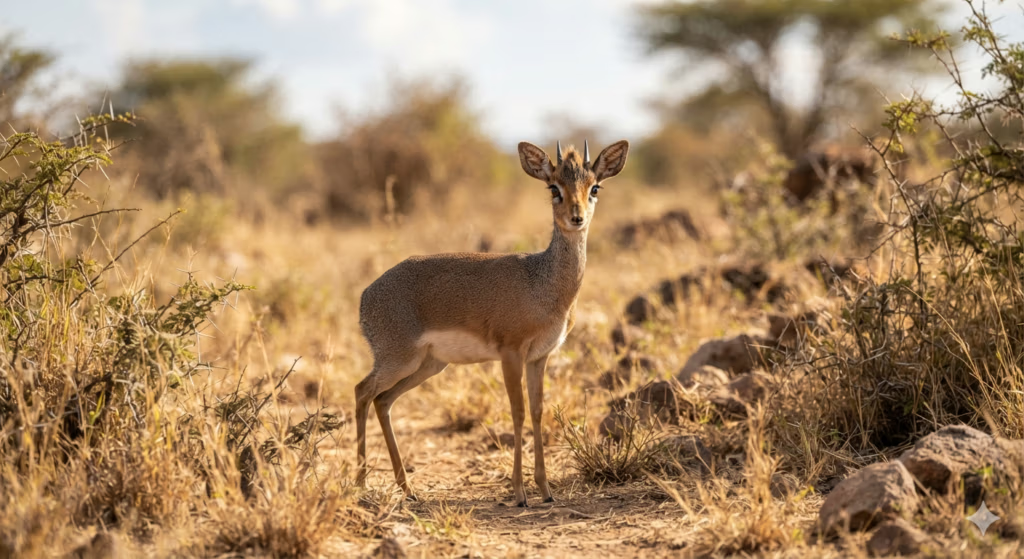

About the Dik-Dik
Info About the Dik-Dik
Dik-diks are very small antelope native to the bushlands of eastern and southern Africa, recognized as among the smallest antelopes in the world. Standing just 12 to 16 inches tall at the shoulders and weighing from 6 and 13 pounds. These miniature mammals feature elongated snouts and large, soulful eyes.
These tiny herbivores are perfectly adapted to the arid savannas. Their elongated snouts contain an evolved cooling mechanism that acts as a natural air-conditioner, preventing overheating in extreme temperatures and minimizing their need for water. Because they get most of their required moisture directly from browsing on acacia leaves, shoots, fruit, and berries, they rarely need to drink.
Because of their small stature, dik-diks are heavily targeted by predators, ranging from big cats and eagles to pythons. To survive, they rely on exceptional eyesight, camouflage, and the ability to reach speeds up to 26 mph in a zigzag pattern. They get their unique name from the shrill, whistling alarm call they make when startled, which warns other animals of nearby danger.
Unlike many grazing animals, dik-diks are monogamous and establish lifelong territories together. They use dark, sticky secretions from preorbital glands below their eyes to mark their range in a shared, ritualized “dunging ceremony”.
Description of the Dik-Dik Antelope
- Size & Shape: They have compact bodies, hare-like hind limbs that are larger than their forelimbs, and a tiny, vestigial tail.
- Coat & Color: Their fur is short and ranges from grizzled gray, yellowish-gray, to reddish-brown on their back and sides, fading to a tan, cream, or grayish-white on their belly and inner legs.
- Snout: Their most defining feature is an elongated, mobile, proboscis-like muzzle. This acts as an internal cooling system, keeping the antelope from overheating in extreme heat.
- Head & Face: They feature a prominent, upright tuft of hair on their crown, striking large dark eyes surrounded by a bold white ring, and a bare black spot beneath the eye containing a scent-marking gland.
- Horns: Only males possess horns. They are short and measure about 3 inches in length, slanted backward, longitudinally grooved, and are often concealed by the hair tuft on their forehead. Females are slightly larger than males but do not grow horns.
Dik-Dik Species / Subspecies
1. Kirk’s Dik-Dik
- Location: East and southwestern Africa (savannas of Kenya, Tanzania, Angola, and Namibia).
- Subspecies: Kirk’s dik-dik has up to six or seven recognized subspecies, with its population sometimes split into northern and southern sibling groups. The most notable subspecies is the Damara.
2. Guenther’s Dik-Dik
- Location: The Horn of Africa (shrublands of Kenya, Somalia, and Ethiopia).
3. Salt’s Dik-Dik
- Location: Northern Horn of Africa, extending into Eritrea and eastern Sudan.
- Subspecies: Depending on the taxonomic authority, up to five or six subspecies are commonly retained.
4. Silver Dik-Dik
- Location: Low, dense thickets along the southeastern coast of Somalia and southern Ethiopia.
Recommended Calibers
Use a maximum 0f a 6mm (.243) caliber rifle to hunt dik-dik or a shotgun loaded with fine birdshot.
Where to Hunt Dik-Dik
Where to Hunt
- Namibia: The Damara dik-dik is only found in the rocky soils and mopane thickets of northern Namibia (often hunted just south of Etosha National Park or in the Erongo Mountains).
- Tanzania: Kirk’s dik-diks are commonly hunted in Masailand and central Tanzania during plains game or dangerous game safaris.
- Ethiopia & Uganda: Guenther’s, Salt’s, and Cordeaux dik-diks are also present in remote regions like the Omo River basin or Karamojo, though they are much less common and logistically harder to arrange.
What is Considered a Trophy Dik-Dik
A dik-dik with horns from 3 to 4 inches long is considered a very good trophy.
Cost to Hunt Dik-Dik
The trophy fee to hunt dik-dik costs from $2,000 to $3,500 depending on the sub-species and outfitter.