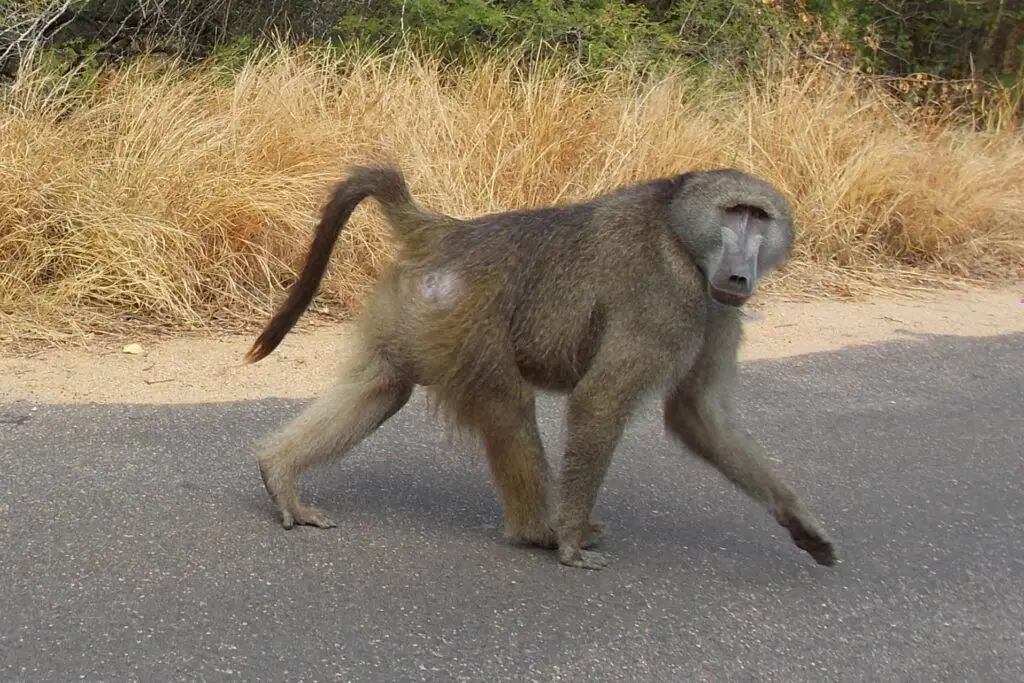

About the Baboon
Info About the Baboon
Baboons are among the world’s largest monkeys. Recognized by their dog-like muzzles and powerful build, these highly adaptable Old World primates thrive across the savannas, grasslands, and rocky cliffs of sub-Saharan Africa and Arabia.
These highly intelligent primates are incredibly social creatures that live in large, structured groups called troops, which can range anywhere from 20 to over 300 members. Within these troops, baboons navigate complex dominance hierarchies. They communicate using more than 30 distinct vocalizations—such as loud barks and grunts—as well as physical gestures like lip-smacking and shoulder-shrugging.
As foragers, baboons are opportunistic omnivores. Their diet spans everything from grasses, fruits, and roots to insects and small mammals. Because of this versatile diet, they inadvertently help aerate the soil and disperse seeds. Although they are successful in their environments, their habit of raiding crops has frequently brought them into conflict with expanding human settlements.
Baboons are usually hunted as an add-on species when hunting on an African safari.
Description of the Baboon
- Head and Face: Elongated, dog-like snouts with nostrils at the end and forward-facing, close-set eyes. Males boast large, sharp, fang-like canine teeth.
- Body & Limbs: Stocky and muscular with long, robust limbs built for quadrupedal (four-legged) walking on the ground.
- Tail: Non-prehensile (cannot grip) and usually carried in a distinct, arched shape.
- Rump: Prominent hairless pads of tough skin on the buttocks that allow them to sit and rest comfortably.
- Coat: Thick, coarse fur that varies by species in colors spanning shades of olive, yellow, silver-grey, brown, and black. Faces and rumps are typically bare and dark or pinkish in color.
- Size: Males typically weigh from 30 to 90 pounds and measure from 20 to 45 inches in body length. Females are much smaller, averaging from 20 to 70 pounds, and from 20 to 30 inches in body length.
- Manes: In some species (like the Hamadryas and Olive baboons), adult males develop a heavy “cape” or thick mane of longer hair around their head and shoulders, which females completely lack.
Baboon Species Variations
- Olive Baboon: Recognized by their grayish-green, olive-toned fur and hairless, black face.
- Chacma Baboon: The largest species, typically dark brown to black in color with a dark purple-black face.
- Hamadryas (Sacred) Baboon: The male features a prominent silver-gray cape/mane, and both sexes have bright pink faces and red rumps.
- Yellow Baboon: Smaller and more slender, characterized by yellow-brown fur and a mostly pale face.
- Guinea Baboon: The smallest of the species, sporting red-violet facial skin and a shaggy, reddish-brown coat.
Recommended Calibers
Use a minimum of a .223 caliber rifle to hunt baboons.
Where to Hunt Baboon
The most popular countries to hunt baboons are: South Africa, Namibia, Zimbabwe, Tanzania, and Uganda.
What is Considered a Trophy Baboon
Any adult male baboon is considered a trophy animal.
Cost to Hunt Baboon
A typical trophy fee for a baboon is from $150 to $1,000.
View Our Hunts