
About the Gaur
Info About the Gaur
The gaur, sometimes called the Indian bison, is the largest and heaviest species of wild cattle in the world. Native to the dense, hilly forests of South and Southeast Asia, these impressive herbivores can stand over 6 feet tall at the shoulders and easily weigh more than a ton.
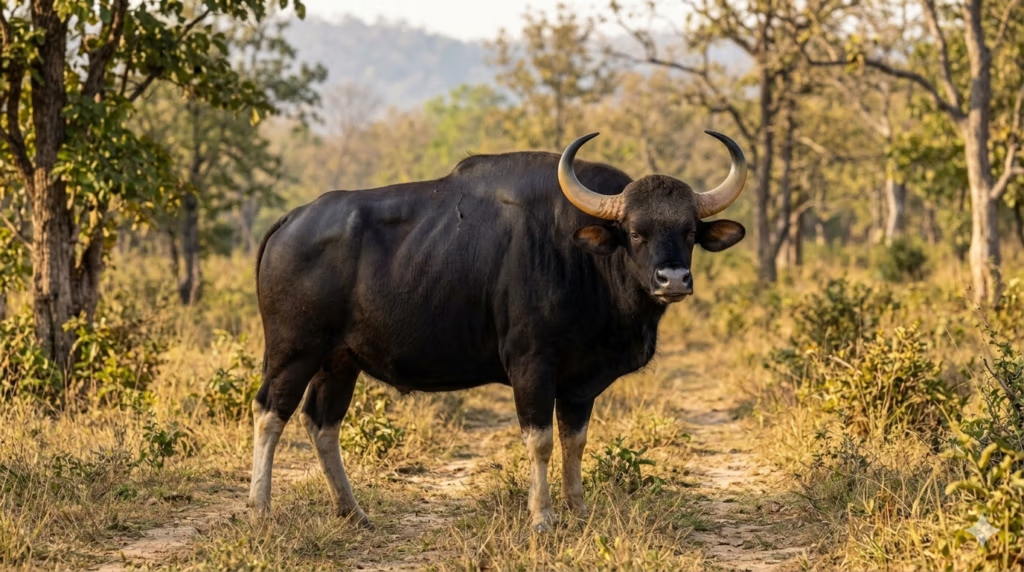
Gaurs are immediately recognizable by their muscular, heavily-built frames, prominent dorsal ridges, and sleek, dark-brown or blackish coats. Another of their defining characteristics is the stark white “stockings” on their lower legs. Both males and females sport heavy, curved horns that can span up to 3 feet in length.
Despite their massive size and intimidating presence, gaurs are generally peaceful and shy, spending their days resting in the shadows and grazing on grasses, bamboo shoots, and leaves. They typically travel in small, close-knit herds led by an experienced female, while older bulls may roam alone. Because they are so large, they have few natural predators; even apex predators like tigers are often reluctant to challenge a fully grown gaur, as these massive animals are more than capable of fiercely defending themselves and their young
Today, gaurs are classified as a vulnerable species. Their populations have faced significant declines over the past several decades primarily due to habitat loss, human expansion, and diseases transmitted by domestic cattle. Conservation efforts remain highly focused on protecting the large, undisturbed forest tracts that these majestic “gentle giants” require to survive and thrive.
Description of the Gaur
- Size & Build: Gaurs have a massive, deep-bodied, and compact build. They stand from 5.5 to 7.2 feet tall at the shoulders. Head-and-body length ranges from 8.2 to 10.8 feet, with a tail of 27 to 39 inches long.
- Weight: Adult males (bulls) weigh from 1,500 to 2,200 pounds, with exceptionally large bulls occasionally approaching 2,800 pounds. Females (cows) are about 25% smaller and lighter than males.
- Coat & Color: Mature males have a sleek, dark blackish-brown to charcoal coat, while females and calves sport a lighter, reddish-brown color.
- Legs (“Stockings”): Regardless of gender, both sexes feature distinct white to tan-colored hair on their lower legs, which makes it appear as though they are wearing knee-high white socks or stockings.
- Dorsal Hump & Ridge: A defining feature of the gaur is the prominent, raised muscular ridge running along the back over its shoulders. This is supported by elongated spines on the vertebrae and is particularly pronounced in adult males.
- Horns: Both sexes possess a pair of horns that grow from the sides of the head and curve gracefully upwards. They can grow from 2.6 to 3.7 feet long. The horns are typically pale green or yellowish at the base and taper to sharp, solid black tips.
- Forehead Ridge: Between the horns, there is a prominent, bulging grey-tan convex ridge on the forehead.
- Dewlap: Gaurs have a distinct fold of loose skin (the dewlap) hanging beneath their chins, which stretches from the throat down to the forelegs.
Gaur Species / Subspecies
Gaur have 3 subspecies:
Indian Gaur:
- Also known as the Indian bison, this is the nominate subspecies. It is the most populous group, featuring a larger and bulkier body structure, and is found primarily in central India, ranging into Nepal and Bhutan.
Southeast Asian Gaur:
- Sometimes called the Indochinese gaur, this highly endangered subspecies is smaller and leaner than its Indian cousin. Its historic range spans from Upper Myanmar into Indochina, with remaining stronghold populations in Thailand, Cambodia, and southern China.
Malayan Gaur:
- Also known as the seladang, this subspecies is native to Peninsular Malaysia. They feature darker, often completely black coats in mature bulls and are typically found in the dense tropical rainforests of the region.
Recommended Calibers
It is best to use a .375 or larger caliber rifle to hunt the gaur.
Where to Hunt Gaur
Gaur are hunted on high fence exotic game ranches in Texas.
What is Considered a Trophy Gaur
Trophy gaur will have horns from 24 to 45 inches long.
Cost to Hunt Gaur
It costs from $8,500 to $16,000+ to hunt gaur.
View Our Hunts