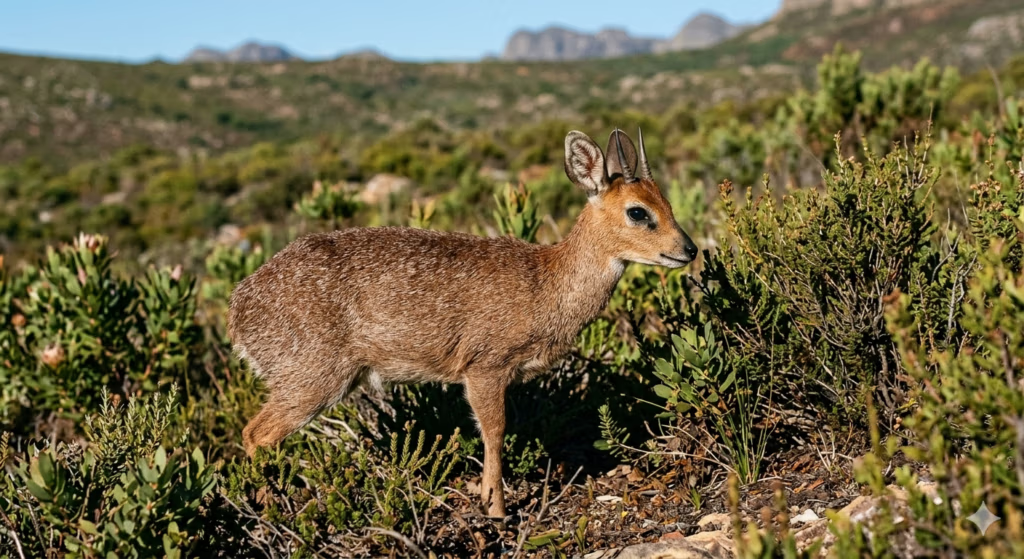

About the Grysbok
Info About the Grysbok
The grysbok is a small, secretive antelope native to southern Africa.
These antelopes are incredibly shy and predominantly nocturnal, choosing to spend the sweltering daylight hours lying motionless in thick brush or rocky outcrops. When darkness falls, they become active and forage for leaves, shoots, and fallen fruits. Remarkably, the grysbok can survive for long periods without drinking open water, extracting all the moisture they need directly from the vegetation they consume.
Behaviorally, they are solitary animals that rely heavily on stealth and camouflage to evade predators. When they are threatened or pursued, they will often sprint in a fast, zigzag pattern or “dive” into thickets to hide rather than confront danger. Because of their elusive nature and habit of freezing completely still in the grass, spotting a grysbok in the wild is considered a rare treat for wildlife enthusiasts.
Description of the Grysbok
These diminutive creatures feature a unique reddish-brown coat interwoven with white hairs. This grizzled texture is exactly how they get their name, as “grys” translates to grey in Afrikaans.
- Height / Weight: Stands from 18 to 24 inches tall at the shoulders, and weigh between 15 and 35 pounds.
- Coat: Composed of stiff, wiry hair. The back and flanks are reddish-brown intermingled with white, while the belly and throat are lighter buff-white or yellowish-brown.
- Head: They have large, wide ears with white borders on the inside, and prominent scent glands directly in front of the eyes.
- Horns: Only males (rams) possess horns. They are short (from 2 to 4 inches long), sharp, and straight.
- Tail: The tail is extremely short (from 1.5 to 3 inches long) and blends into the body, making it practically invisible.
Grysbok Species / Subspecies
They are divided into two distinct species:
Cape Grysbok
Also known as the southern grysbok, this species is entirely endemic to the southern coastal regions and mountain valleys of South Africa (primarily the Western and Eastern Cape).
Sharpe’s Grysbok
Subspecies: Two subspecies are generally recognized:
- (Sharpe’s grysbok): Found in the more northern parts of the species’ range (north of the Zambezi River, extending into Tanzania).
- Limpopo grysbok: A slightly larger and marginally darker subspecies found in the southern portions of the range (Zimbabwe, Mozambique, and South Africa).
Recommended Calibers
The ideal rifle to hunt a Grysbok is a flat-shooting, small-bore centerfire, such as a .223 Remington, .22 Hornet, or .243 Winchester, loaded with 45 to 55-grain non-expanding monolithic solid bullets.
Another popular option is to use a 12-gauge or 20-gauge loaded with small birdshot (e.g., #5, #6, or #7) . It provides an excellent pattern for snap-shooting in thick brush at very close ranges (15 to 30 yards), anchoring the animal immediately without large exit wounds.
Where to Hunt Grysbok
Cape Grysbok Hunting Locations:
- Eastern Cape Province: This is the absolute top region for hunting cape grysbok, offering the highest density of populations.
- Western Cape Province: You can find outfitters guiding hunts along the southern mountain valleys and coastal Fynbos biomes
Sharpe’s Grysbok Hunting Locations
- Northern South Africa: Most hunts take place within the Limpopo Province (especially around the Soutpansberg Mountains) and the Mpumalanga Province.
- Mozambique: Widely available to hunt in various lowveld concession territories across the country.
- Zimbabwe & Zambia: Found in dense, stony kopjes and thick scrub zones managed by big-game outfitters.
- Tanzania: Available on specific 16-day or 21-day hunting licenses, primarily in southern and western woodland blocks.
Restrictions
- TOPS Permits: In South Africa, both species are classified under Threatened or Protected Species (TOPS) regulations. Your outfitter must apply for this permit in your name before you arrive.
- Night Hunting Allowances: Grysbok are highly nocturnal and secretive. Hunting them often requires special nocturnal spotlighting permits, which are strictly regulated by provincial nature conservation authorities.
View Our Hunts