

About the Hartebeest
Info About the Hartebeest
The hartebeest is a large, uniquely shaped African antelope highly adapted for savanna and grassland survival. Known for its sloping back, extremely long face, and distinctively curved horns, it relies on speed and endurance to evade predators. They are social grazers that gather in massive, vigilant herds across sub-Saharan Africa.
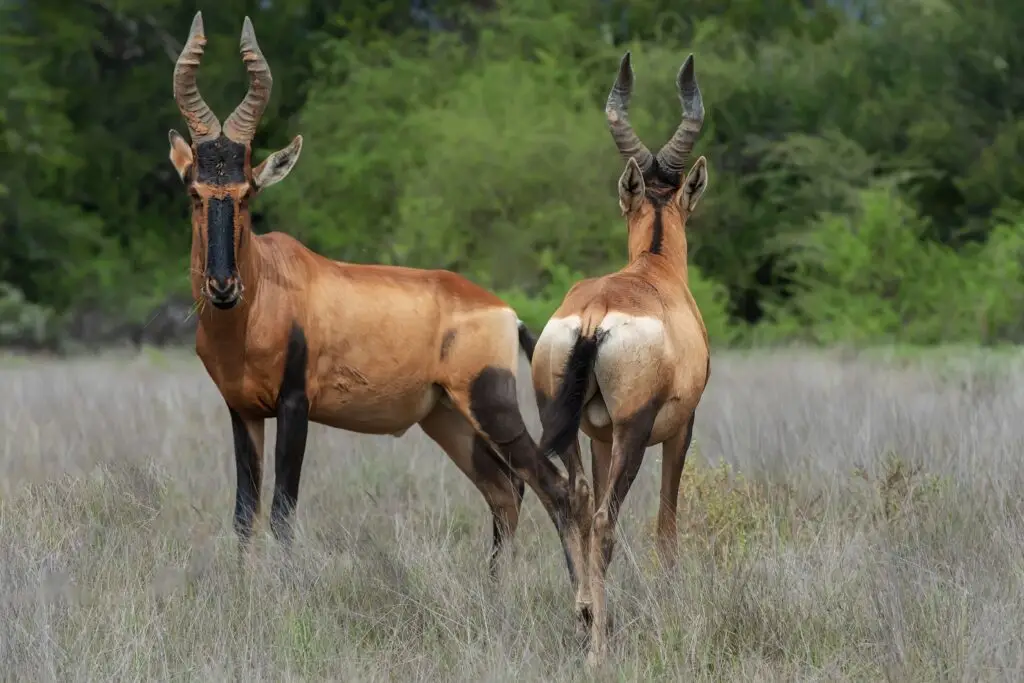
Physically, the hartebeest features long, slender legs and a notably narrow, elongated muzzle that allows it to graze efficiently on various grasses. Both sexes possess unique, heavily ringed horns that curve outward and inward, frequently forming a prominent heart-like shape from the front.
These antelopes are highly gregarious and thrive in savannas, open plains, and scrublands, where they feed almost exclusively on grass. Because their natural habitats often experience dry spells, hartebeests have developed remarkable fluid retention abilities, allowing them to extract necessary moisture from their diet rather than visiting waterholes daily. Within their social groups, territorial adult males defend prime grazing patches, while females form smaller dominance groups to protect their calves.
Description of the Hartebeest
Core Measurements
- Head-and-Body Length: from 68 to 96 inches in length
- Shoulder Height: from 45 to 56 inches in height at the shoulders.
- Weight: from 220 to 440 pounds.
Key Physical Features
- Sloping Back: A prominent, high hump over the shoulders slopes sharply downward to the hindquarters, terminating in a black-tasseled tail.
- Head & Neck: Features an exceptionally long, narrow rostrum, supported by a short, thick neck. Large glands sit prominently below the eyes.
- Horns: Found on both males and females, the horns grow upward and outward before curving backward, generally forming a bracket or heart shape. Male horns are generally thicker and more massive at the base.
- Coat & Coloration: The coat is short and fine. Coloration varies significantly by subspecies—ranging from pale sandy-brown (Western) to reddish-brown (Red) and dark mahogany (Cape). Many subspecies display distinct black markings on the face and legs, contrasting with pale white or yellowish patches on the chest and rump.
Hartebeest Species / Subspecies
Eastern Lineage
- Coke’s Hartebeest: Also known as the kongoni, found in northern Tanzania and Kenya.
- Lelwel Hartebeest: Ranging from Uganda and Sudan to Chad.
- Swayne’s Hartebeest: A localized and endangered subspecies primarily found in Ethiopia’s Rift Valley.
- Tora Hartebeest: Found historically in eastern Sudan and Eritrea.
Western Lineage
- Western Hartebeest: Historically ranging across West Africa to Senegal.
- Bubal Hartebeest: The extinct nominate subspecies that once roamed North Africa above the Sahara.
Southern Lineage
- Red Hartebeest: Found in southern Africa (South Africa, Botswana, Namibia).
- Lichtenstein’s Hartebeest: Distributed from Tanzania south to Mozambique and Zambia.
Recommended Calibers
Use a minimum of a 6.5mm caliber rifle to hunt hartebeest.
Where to Hunt Hartebeest
- To hunt the hartebeest, you will need to book a safari in sub-Saharan Africa. The most popular species (the Red Hartebeest and Coke’s Hartebeest) are best hunted in South Africa, Namibia, Botswana, and Tanzania.
- Lichtenstein’s Hartebeest: Distributed in south-central regions; hunted primarily in Tanzania, Mozambique, and Zambia.

- Western & Lelwel Hartebeest: Hunted in western/central African countries such as Cameroon.
What is Considered a Trophy Hartebeest
A red hartebeest with horns measuring 22 inches or longer is considered a trophy animal.
A Lichtenstein hartebeest with horns measuring 18 inches or longer is considered a trophy animal.
Cost to Hunt Hartebeest
The trophy fee to hunt red hartebeest costs between $800 and $1,500.
The trophy fee to hunt Lichtenstein hartebeest costs between $1,200 and $3,500. However the countries that offer this species have daily hunting fees ranging from $500 to $1,500 per day which greatly increases the cost.
View Our Hunts
Related Information
South Africa Hunt Info
Hartebeest Species Info
Hartebeest Hunt Info