
About the Caribou
Info About the Caribou
The caribou (known as reindeer in Europe and Asia) is one of the most resilient and iconic survivors of the far north. Belonging to the deer family, they are uniquely adapted to thrive in extreme subarctic and arctic environments. Perhaps the most defining feature of these magnificent herbivores is that both males and females grow antlers, which they use to forage for winter food and defend their territories.
Caribou possess large, hollow hairs in their coat that trap air for ultimate insulation and act as built-in flotation devices when swimming across icy rivers. During the winter, their specially adapted hooves widen and act like snowshoes, while their hollowed-out centers function as shovels to scrape away snow and access hidden vegetation. Most notably, they are the only mammals capable of utilizing specialized microbiota to metabolize lichen—a primary food source during the scarce winter months.
In North America, many barren-ground caribou herds undertake staggering long-distance migrations, traveling upwards of 3,000 miles a year in search of food and safe calving grounds. These massive treks—where herds of up to 200,000 gather on the arctic tundra in late spring—are some of the most impressive land migrations on Earth. Unfortunately, global caribou and reindeer populations have seen significant declines over the last few decades.
Description of the Caribou
Specific physical characteristics of the caribou include:
- Size and Weight: Stand from 3.6 to 4.6 feet tall at the shoulders and measure up to 8 feet long. Adult males (bulls) weigh from 350 to 400 pounds (occasionally reaching up to 700 pounds), while females (cows) are noticeably smaller, weighing from 175 to 330 pounds.
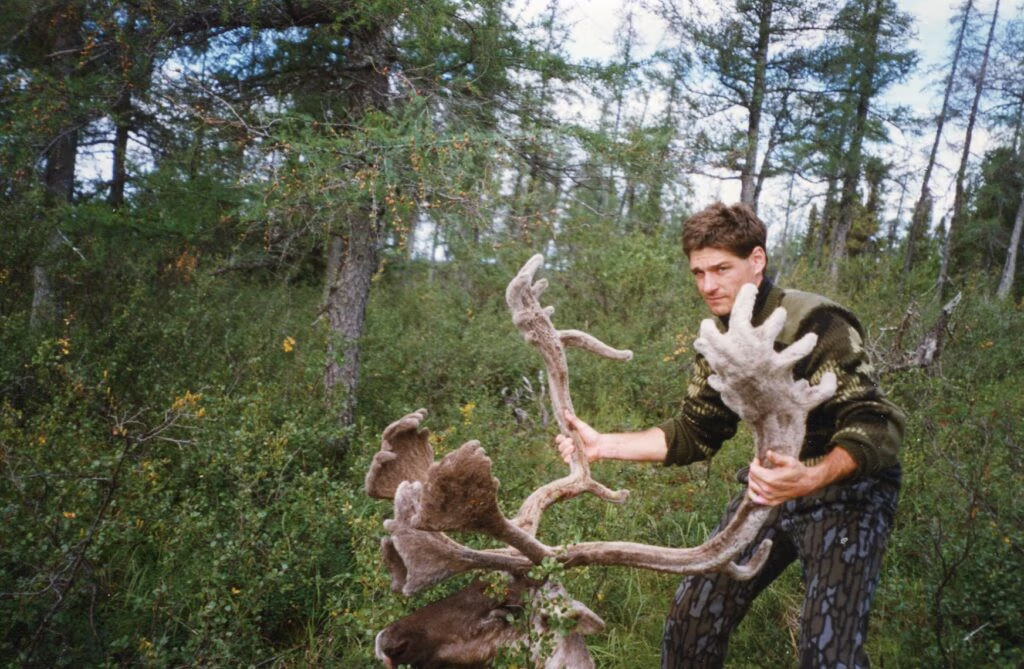
- Antlers: They are the only deer species where both sexes grow antlers. Male antlers are large, massive, and highly branched, while female antlers are shorter and more slender. Males shed theirs from November to April, and females shed theirs from May to June.
- Hooves: Caribou possess large, concave, nearly circular hooves with widely separated dew claws, allowing them to easily traverse deep snow, muskeg, and wetlands. The hooves also act as paddles for swimming.
- Coloration: Their coat changes seasonally. In the spring and fall, they are typically a clove or dark brown, contrasting with a white neck, shoulders, rump, and feet. In the winter, their fur can fade to a greyish or almost entirely white coloration.
- Hair: Their fur consists of thick, hollow hairs. This trapped air provides incredible buoyancy in water and excellent insulation against sub-zero arctic temperatures.
- Eyes: Caribou have an incredible physiological adaptation where their eyes change color with the seasons. Their eyes are golden-yellow in the summer but shift to a deep, reflective blue during the dark winter months to help them detect light more effectively.
- Scent Glands: They possess specialized scent glands located at the base of their ankles. When threatened, they rear up on their hind legs and release a musky scent to warn the rest of the herd of danger.
Caribou Species / Subspecies
North American Subspecies
- Barren-ground Caribou: The most populous group, found in the vast tundras and boreal forests of Alaska and mainland Canada. They are known for undertaking some of the longest land migrations on Earth.
- Central Barren-ground Caribou: Lives in the Nunavut and the Northwest Territories.
- Woodland Caribou: The southernmost subspecies, primarily inhabiting mature forests and peatlands across Canada and parts of the contiguous U.S.. They include sedentary boreal groups and migratory mountain populations.
- Mountain Caribou: A large caribou the lives in British Columbia, Yukon, and Northwest Territory of Canada.
- Quebec-Labrador Caribou: Found in Northern Quebec and Labrador.
- Greenland Caribou: A slightly larger subspecies native to the tundra regions of Greenland.
Eurasian Subspecies (Reindeer)
- European Reindeer: The only subspecies that has been widely domesticated, native to the Arctic regions of northern Europe and Russia.
- Finnish Forest Reindeer: A larger, forest-dwelling subspecies found primarily in parts of Finland and northwestern Russia.
- Svalbard Reindeer: The smallest of all caribou/reindeer, uniquely adapted to the extreme, isolated environment of the Svalbard archipelago in Norway.
Recommended Calibers
Use a minimum of a 6.5mm caliber rifle to hunt caribou.
Where to Hunt Caribou
This list names some of the best places to hunt caribou:
1. Alaska
- Newfoundland: This is the best place for non-residents to hunt the elusive Woodland Caribou.
- Yukon & Northwest Territories: Premier destinations for massive Mountain Caribou.
- Northern Manitoba & Nunavut: Prime territories for remote Central Canada Barren Ground Caribou.
Cost to Hunt Caribou
The cost to hunt caribou varies greatly based on if you hunt from a DIY drop camp to a fully guided hunt. It can cost anywhere from $3,500 to $30,000.