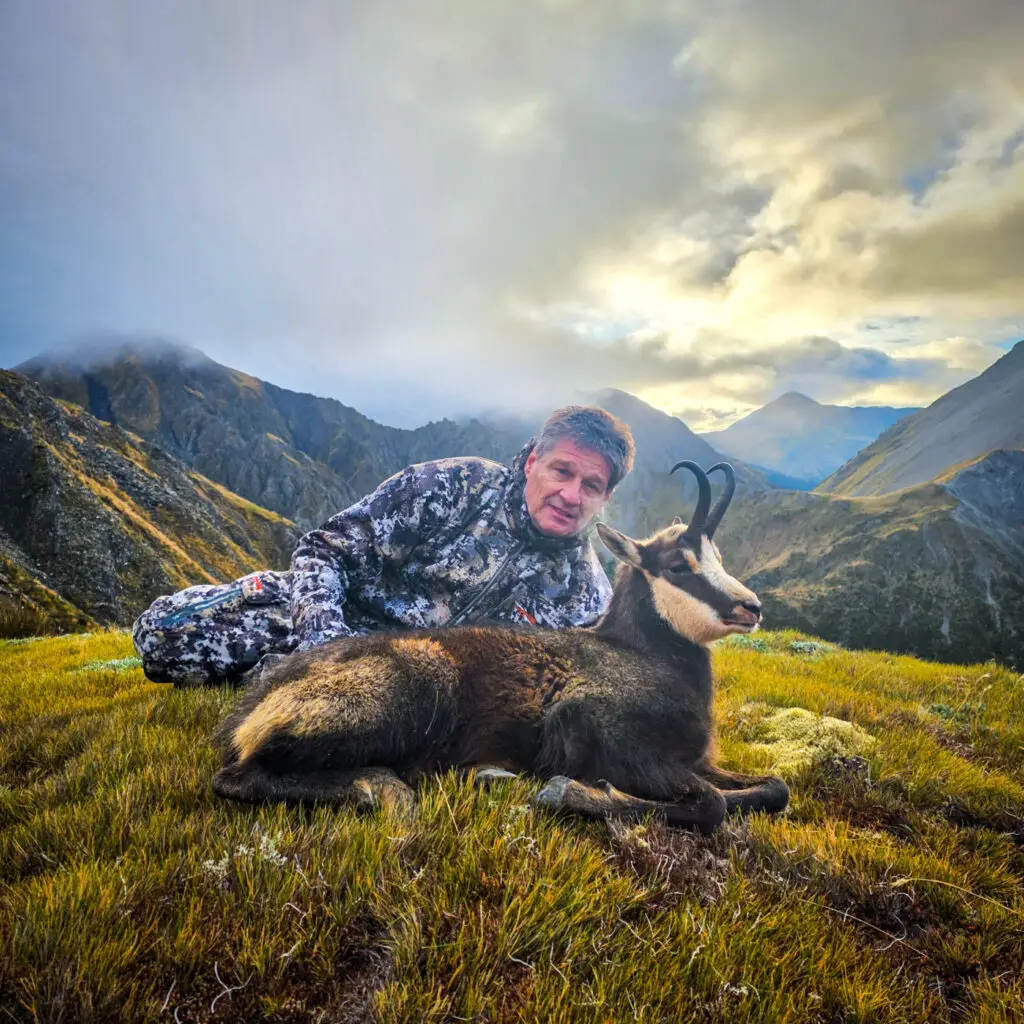

About the Chamois
Info About the Chamois
The chamois is an incredibly agile goat-antelope native to the rugged mountain ranges of Europe and Asia. Best known for its surefootedness at dizzying heights, this hardy herbivore navigates sheer, rocky cliffs and deep winter snow with ease.
Description of the Chamois
Physically, the chamois is built for extremes. It features short, sharply hooked horns and specialized hooves with hard, gripping edges and flexible, leather-like centers. Their coats undergo seasonal color changes. During the summer, they boast a light, tawny-brown fur, which transitions to a thick, chocolate-brown to near-black coat in the winter to better absorb sunlight. They are incredibly athletic, capable of bounding up to 6.5 feet high and leaping distances of 20 feet.
Chamois stand from 28 to 31 inches tall at the shoulders and weigh from 55 to 110 pounds. Both sexes have horns that measure from 6 to 13 inches long. Males have longer more curved (hook-like) thicker horns than females.
Males are called bucks (or rams in some places). Females are called does.
Behavior of the Chamois
Chamois exhibit distinct social structures based on the season and their sex. Females and their young gather in small herds of 15 to 30 individuals, while adult males typically live solitary lives until the late-autumn breeding season. During the rut, males fiercely compete for females, chasing one another at breakneck speeds across perilous terrain.
Chamois Species
There are two species of chamois, the Northern Chamois and the Southern Chamois.
Northern Chamois
- Alpine Chamois: Found throughout the Alps, this is the most widespread and well-known subspecies.
- Balkan Chamois: Inhabits the mountain ranges of the Balkan region.
- Carpathian Chamois: Endemic to the Carpathian Mountains in Romania.
- Chartreuse Chamois: Found in the Chartreuse Massif of the French Alps.
- Tatra Chamois: Found in the Tatra Mountains of Slovakia and Poland.
- Anatolian/Asia Minor Chamois: Native to the mountains of Turkey.
- Caucasian Chamois: Inhabits the Caucasus Mountains.
Southern Chamois
- Pyrenean Chamois: Lives in the Pyrenees mountains between France and Spain.
- Cantabrian Chamois: Found in the Cantabrian Mountains of northern Spain.
- Abruzzo/Apennine Chamois: Native to the central Apennine mountains in Italy.
Recommended Calibers
The Ultimate Chamois Calibers include:
- 6.5 Creedmoor / 6.5 PRC: Built for the mountains. These rounds deliver a flat trajectory, minimal recoil, and high ballistics that slice through unpredictable alpine crosswinds.
- .243 Winchester: This is the gold standard for dedicated chamois hunting. Fast, accurate, and flat-shooting, it offers exceptional performance at medium-to-long ranges.
- 7mm-08 / .308 Winchester: These are a versatile New Zealand classic. These local favorites provide inherent accuracy and the knockdown power needed if your hunt includes larger game.
Where to Hunt Chamois
Chamois are hunted in New Zealand and Europe. The south island of New Zealand is the premium place to pursue free range Chamois (Alpine Sub-species). They have their best coats in New Zealand during the winter (May through July).
In Europe, Spain and France have the Pyrenees sub-species, Macedonia and Bulgaria have the Balkan sub-species, Romania has the Carpathian subspecies, and Turkey has the Anatolian sub-species.
What is Considered a Trophy Chamois
A typical trophy New Zealand chamois horn measures from 9 to 10 inches in length, representing a mature buck with excellent characteristics. Truly exceptional, world-class trophies boast a length of 10 to 14 inches. Across all mature sizes, expect a thick, solid base with a circumference of 2 to 3 inches around.
Cost to Hunt Chamois
The cost to hunt a chamois varies from $3,500 to $15,000 depending on the country hunted and whether or not a helicopter is used.
View Our Hunts