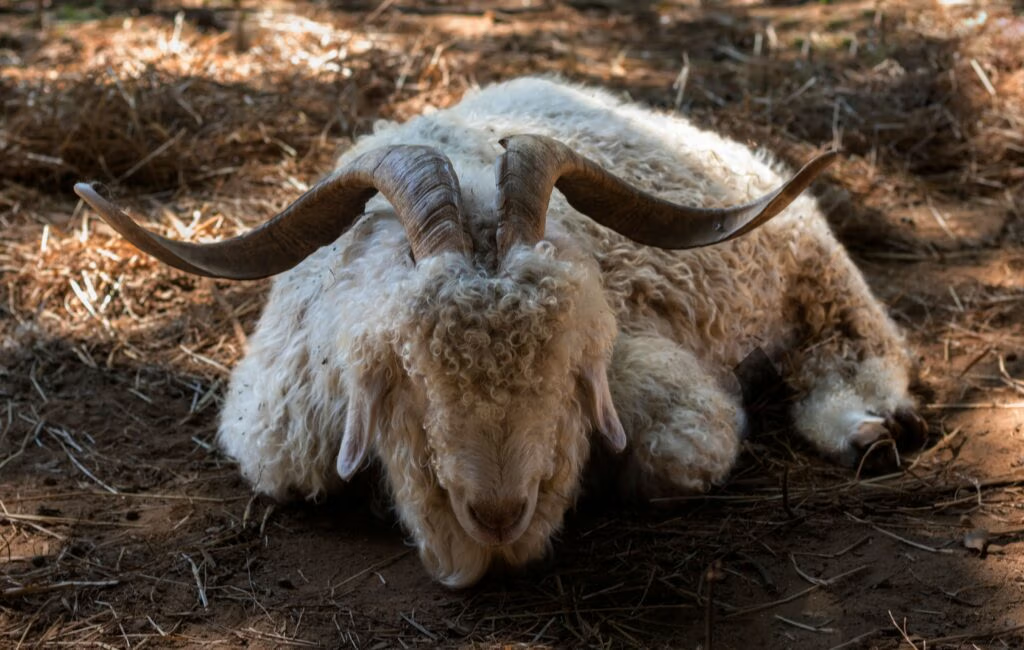

About the Angora Goat
Info About the Angora Goat
The Angora goat is an ancient, delicate breed originating from the Ankara region of Turkey, historically known as Angora. Renowned for its luxurious and dazzlingly white fleece, it is the only breed of goat that produces mohair rather than wool. Because their hair grows continuously, these small ruminants are typically shorn twice a year, yielding several pounds of highly sought-after fiber per harvest.
Because their coats are so dense and continuous, Angora goats have unique physiological needs. They are more susceptible to parasites than many other livestock breeds and are particularly sensitive to cold, wet weather immediately after shearing. To stay healthy, they require high-quality, well-balanced diets to support the energy-intensive process of growing a heavy fleece, as well as dry, draft-free shelters. Like other goats, they are primarily browsers that thrive by eating brush, weeds, and the leaves of woody plants, making them excellent land clearers.
The mohair they produce is incredibly versatile, famous for its strength, brilliant luster, and remarkable ability to take dye. Because it is a smooth hair rather than a scaled wool fiber, it is durable and soft against the skin, making it highly valued in the apparel and upholstery trades. While the color is typically pure white, some breeders also cultivate colored Angoras to create textiles with natural pigmentation. Their gentle, curious, and docile temperaments also make them popular among hobby farmers and fiber artisans worldwide.
Description of the Angora Goat
Body
- Weight: Mature males (bucks) weigh from 180 to 225 pounds, while females (does) weigh from 70 to 110 pounds.
- Height: Bucks stand approximately 48 inches tall at the shoulders, with does reaching about 36 inches.
- Frame: They have a compact, deep, and broad barrel with well-sprung ribs and strong, straight limbs.
Coat & Fiber
- Texture: The coat is composed of mohair—a soft, silky, and elastic fiber that differs chemically from sheep’s wool. It grows in long, distinct ringlets or flat, wavy locks that can reach lengths of from 8 to 10 inches or more.
- Coverage: With the exception of the face, ears, and lower legs, the entire body is covered in this dense fleece.
- Color: While they are most commonly a dazzling white, their coats can also occur naturally in shades of black, brown, and grey.
Head & Horns
- Face: They feature a clean, fleece-free face with a small head, broad muzzle, and large, drooping (pendulous) ears.
- Horns: Both sexes typically have horns that curve backwards. Bucks boast strong, pronounced, and twisted horns that can reach two feet in length, whereas the female (does) have shorter, straighter horns (about 9 to 10 inches long).
Recommended Calibers
Use a minimum of a 6mm (.243) caliber rifle to hunt angora goats.
Where to Hunt Angora Goat
Angora goats are hunted on high fence exotic game ranches in Texas and Tennessee.
What is Considered a Trophy Angora Goat
An Angora goat with horns measuring 30 inches or more is considered a trophy animal.
Cost to Hunt Angora Goat
Angora goats generally have a $1,200 to $3,000 trophy fee, plus the daily rate for hunting at the high fence preserve.
View Our Hunts