
About the Hog (Feral)
Info About the Hog (Feral)
Hog hunting in the USA centers around managing an estimated 6 to 9 million invasive feral hogs that cause over $1.5 billion in agricultural and ecological damage annually. Because they are a destructive, non-game species, states generally offer year-round hunting with no bag limits to encourage population control.
Texas is the undisputed epicenter of the American hog population, harboring millions of feral pigs. In the Lone Star State, hunters can pursue hogs year-round, even at night over bait or with thermal optics, and with no hunting license requirements on private land. Other major hubs for swine hunting include Oklahoma, Florida, Georgia, and Alabama. While private land access provides the best success, hunters can also target hogs on public Wildlife Management Areas (WMAs) in places like Georgia and Arkansas, though stricter weapon and season regulations apply.
Because hogs primarily feed from dusk to dawn, hunting strategies vary. Common daytime methods include spot-and-stalk and evening sits over travel routes or feeders, while night hunts using thermal or night-vision optics are highly productive. Some hunters prefer the action of using trained bay and catch dogs to corner the boars. For meat consumption, smaller wild sows and younger boars are generally preferred, producing a lean, rich pork that is highly valued.
Description of Feral Hogs
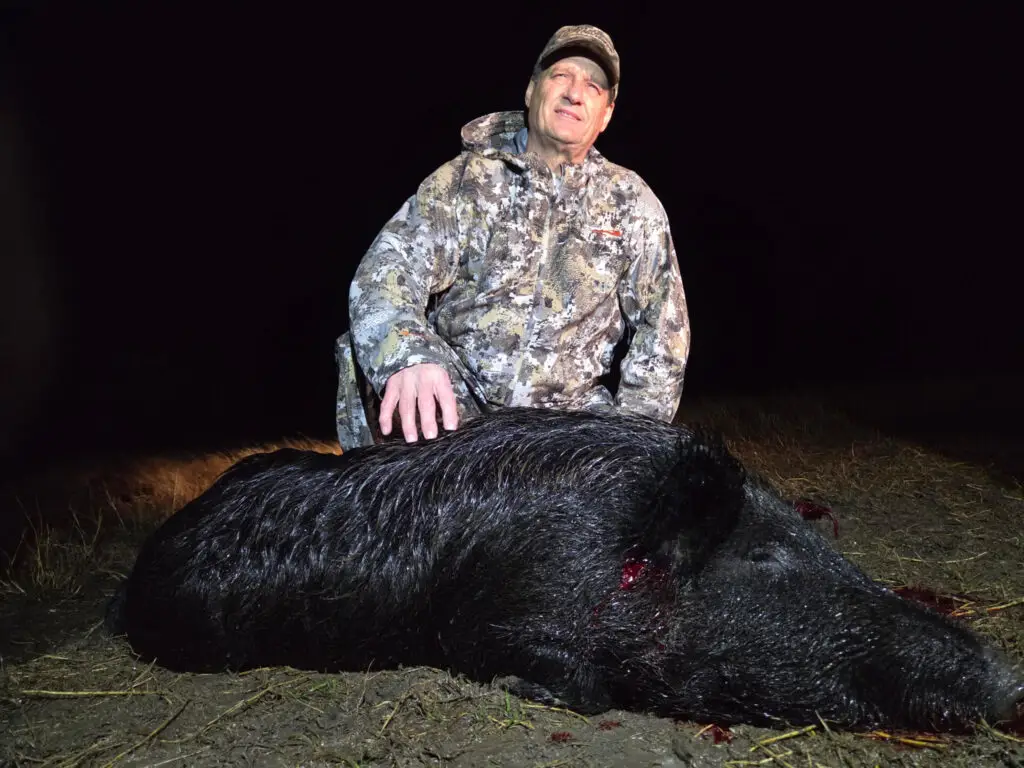
Feral hogs are stout, muscular animals characterized by a thick, wedge-shaped body, a flexible flattened snout, and coarse bristly hair. Their coat colors range widely from black, brown, and red to spotted patterns, while juveniles are often born with distinct reddish-brown coats and yellowish longitudinal stripes.
Average adults stand about 36 inches tall at the shoulders and measure up to 60 inches in length. Males (boars) generally weigh from 130 to 440 pounds., while females (sows) average from 77 to 330 pounds, though much larger exceptions exist.
They are leaner and more muscular than domestic hogs, featuring heavier shoulders, longer legs, and a longer, straighter tail.
Both sexes possess four continuously growing tusks. The upper and lower sets gnash against one another, creating and maintaining razor-sharp edges.
Their fur consists of stiff, bristly hairs. They typically have little body fat compared to domestic pigs.
Recommended Calibers
The best rifle for hog hunting is anything from a 6.5mm up to any of the .30 caliber rifles. Though, a bolt action rifle is often used, AR styled rifles are very popular and effective. Because feral hogs are thick-skinned, muscular, and have a dense shoulder plate, you need a caliber with excellent penetration and knockdown power.
Where to Hunt Hog (Feral)
Both free-range and high-fence hunts are very popular. Texas and Oklahoma are the most popular hunting destinations.
View Our Hunts