
About the Arabian Oryx
Info About the Arabian Oryx
The Arabian oryx is the smallest oryx and a resilient antelope native to the arid deserts of the Arabian Peninsula. Famous for its striking appearance and incredible survival skills, it is a culturally iconic animal frequently featured in the heritage and symbols of several Gulf nations.
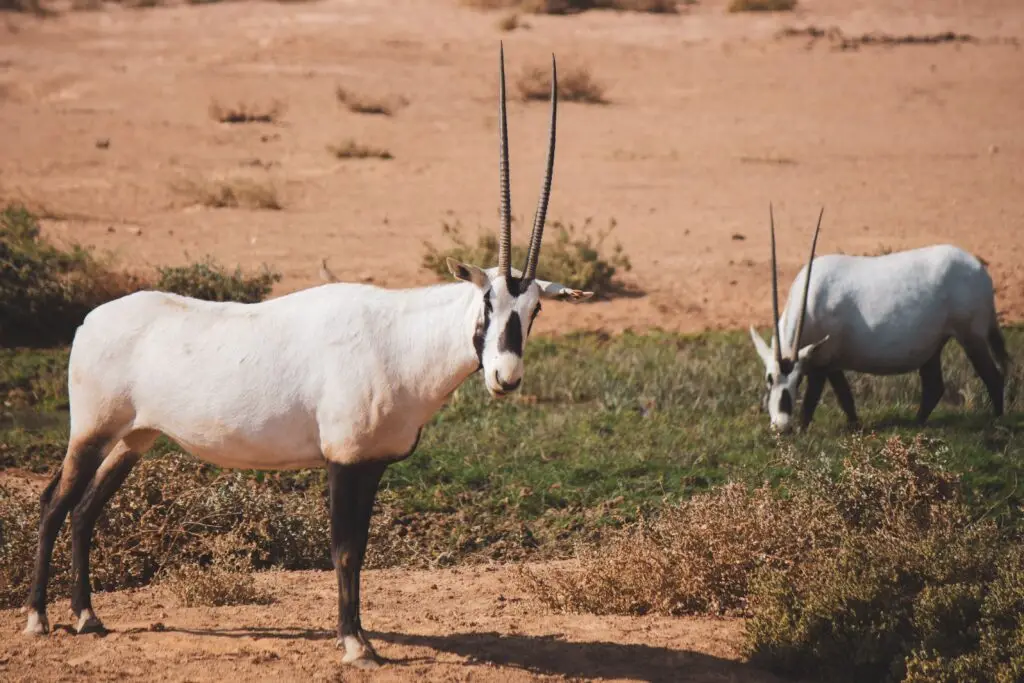
These antelope are highly specialized for thriving in extreme desert environments. Their brilliant, almost-pure white coats reflect the scorching sun, while thick undercoats trap body heat during freezing desert mornings. They also possess a specialized network of veins and arteries in their noses that acts as a natural cooling system for their blood and brain. Remarkably, the Arabian oryx can go for several weeks without drinking water, extracting all the moisture they need from desert vegetation, succulents, and dew.
Another defining feature of both male and female Arabian oryxes is their exceptionally long, slender, and slightly curved horns, which can grow up to 30 inches in length. These horns have even inspired the legendary myth of the unicorn. In the wild, they are gregarious animals, usually gathering in small herds of up to 15 individuals. They are nomadic wanderers, able to detect rainfall and fresh plant growth from up to 50 miles away and will travel vast distances to find it.
The history of the Arabian oryx is a remarkable tale of conservation. Heavily hunted for its meat, hides, and horns, the species was unfortunately declared extinct in the wild in the early 1970s. Fortunately, captive-breeding and reintroduction programs—spearheaded by zoos and conservationists worldwide—successfully brought the species back from the brink of extinction. In 2011, following decades of reintroduction efforts, the IUCN updated the Arabian oryx status to vulnerable, making it the first animal to revert to a lower risk category after being officially listed as extinct in the wild.
Description of the Arabian Oryx
The physical traits of the Arabian oryx are highly adapted to the harsh desert environment:
Dimensions & Weight:
- Shoulder Height: from 35 to 55 inches long.
- Weight: from 145 to 165 pounds.
- Body Length: from 60 to 92 inches long.
Body and Horns:
- Coat & Markings: The almost luminous white color of their coat reflects the sun’s harsh rays in the summer, while its thick texture traps body heat on freezing desert nights. They have dramatic, dark markings on the face, the bridge of the nose, and the lower legs.
- Horns: Both sexes possess long, slender, almost spear-like horns that range from 20 to 59 inches in length. The horns curve slightly backward and are used for defense and dominance displays. Female horns are typically longer and thinner than those of males.
- Body Structure: They have a stout, compact frame with a noticeable hump over their shoulders, a thick horse-like neck, a short mane, and a long tail ending in a dark, bushy tuft.
- Hooves: They possess large, broad, and splayed hooves that act as natural snowshoes, preventing them from sinking into loose desert sand.
Recommended Calibers
Use a minimum of a .30 caliber rifle to hunt Arabian Oryx.
Where to Hunt Arabian Oryx
The main place to hunt the Arabian Oryx is on an exotic game ranch in Texas. South Africa is also an option.
Texas
Texas is home to the most robust private populations of Arabian oryx in the world. Classified as exotic game, they can be hunted year-round.
South Africa
Several massive private game reserves in the hyper-arid Karoo Desert and Eastern Cape Province maintain thriving, wild-behaving herds of Arabian oryx.
What is Considered a Trophy Arabian Oryx
Several factors define a high-quality trophy Arabian Oryx.
- Horn Length: A typical trophy features straight, symmetrical horns measuring from 26 to 28 inches. Horns stretching past 28 inches are considered excellent. Females often possess longer, more slender horns than males, but males boast thicker bases.
- Mass and Rings: Deeper, well-spaced ridges and thick horn mass near the base distinguish a mature, trophy-class bull.
- Hide Contrast: A prime trophy features a pure white body contrasting sharply with dark chocolate or black markings on the face, neck, and legs.
Cost to Hunt Arabian Oryx
An Arabian Oryx hunt will cost from $8,000 to $15,000 including the daily rate and the trophy fee.
- Texas: Average cost is from $9,500 to $14,000+
- South Africa: Average cost is from $8,000 to $12,000 as a trophy fee addon to a larger safari booking
View Our Hunts