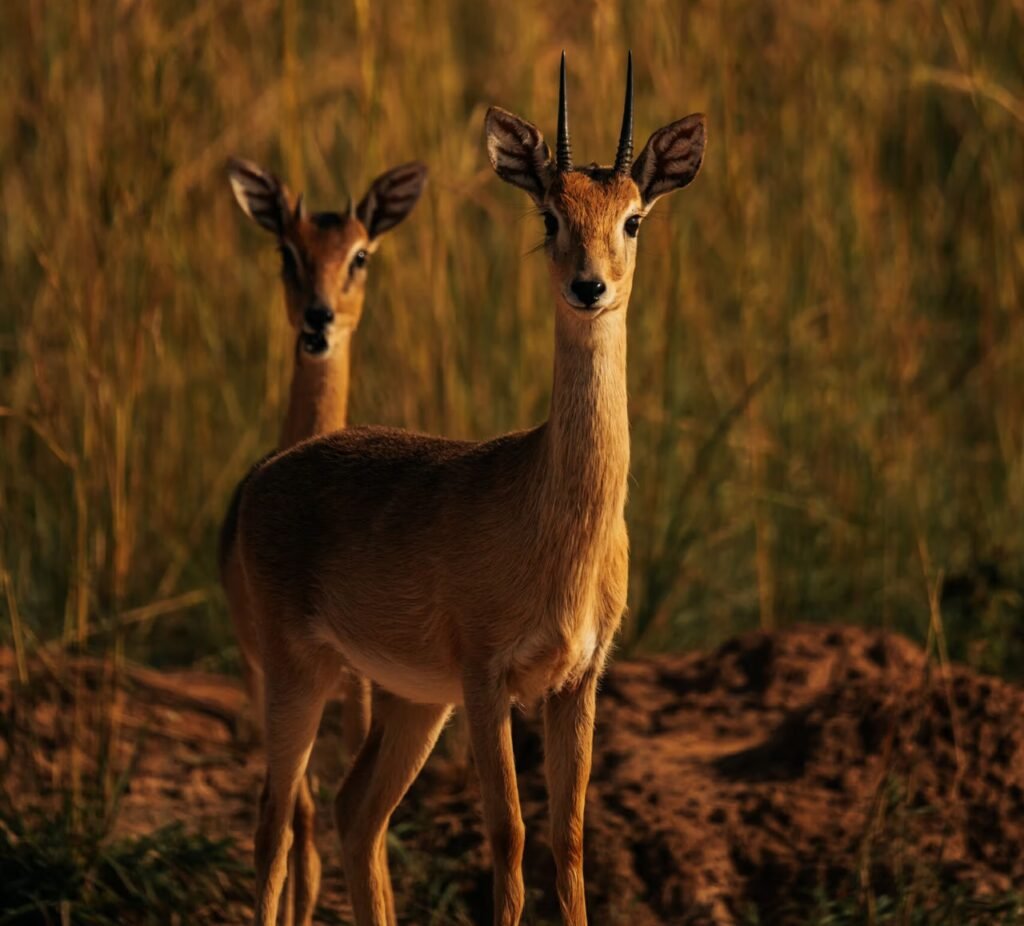

About the Oribi
Info About the Oribi
The oribi is a slender, swift African antelope that thrives in open grasslands and savannas.
As a specialized herbivore, the oribi spends its day grazing on fresh grasses and occasionally foraging for flowers and mushrooms. They have a highly unique social structure; while other small antelopes typically live in strict monogamous pairs, oribis adapt their mating systems to their specific habitats, ranging from solitary pairings to multi-female herds and even cooperative male territories. Males are fiercely territorial and use pre-orbital glands on their faces and communal dung heaps to mark the boundaries of their home ranges.
When threatened by predators like lions, leopards, or wild dogs, the oribi relies on its incredible camouflage, often flattening itself into the long grass to stay hidden. If a predator gets too close, the antelope bursts into a rapid, zigzagging run, reaching speeds from 24 to 31 mph. They are also famous for “stoting”—an evasive maneuver characterized by arching the back and performing stiff-legged vertical leaps—to startle predators and warn other oribis of danger.
Description of the Oribi
Body & Coloring
- Coat: Sleek and glossy, ranging from light yellowish-tan to a rich, bright reddish-brown.
- Contrasting Underparts: The chin, throat, inner ears, belly, and rump are a stark, bright white.
- Shape: They have a slightly raised back, a long neck, and narrow limbs.
- Tail: A short, bushy tail that is usually brown or black on the outside and white on the inside.
Head & Face
- Facial Markings: Features large oval ears, a narrow muzzle, and a prominent bare black glandular spot below each ear. A noticeable white line of fur also runs over their eyes.
- Horns: Only males (rams) have horns. They are thin, straight, spikelike, and usually measure from 3 to 7 inches in length, with smooth tips and rings at the base.
Specialized Features
- Scent Glands: Oribis have highly developed, prominent preorbital glands (scent glands) near the inner corners of their eyes, appearing as distinct vertical folds.
Recommended Calibers
Centerfire rifles chambered in the .22 calibers up through the 6mm calibers work great for the oribi.
Where to Hunt Oribi
You can hunt oribi in the following African nations: South Africa, Mozambique, Tanzania, Central African Republic, Cameroon, Benin, Burkina Faso, Ethiopia, Uganda, and Zambia.