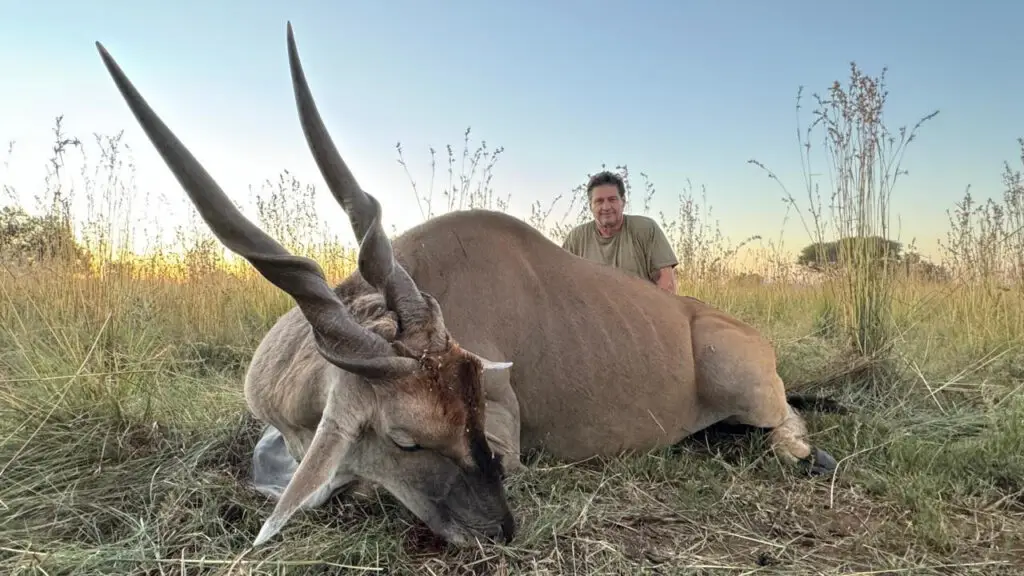

About the Eland
Info About the Eland
The eland is the largest of all African antelopes, with massive males often weighing up to 2,200 pounds depending on the subspecies. Despite their ox-like build, these herbivores are surprisingly agile and are renowned for their ability to leap heights of up to 8 feet from a standing start.
The eland is native to the savannas, woodlands, and semi-deserts of eastern and southern Africa. Their flexible diet—feeding on grasses, leaves, and various fruits—allows them to extract moisture from plants, meaning they can survive for extended periods without drinking open water. One of their most fascinating characteristics is a distinctive, loud “clicking” sound produced by their hooves as they walk, which carries a considerable distance to help the herd stay in communication.
Description of the Eland
Males (Bulls) are much larger than females, typically weighing from 880 to 2,200 pounds, and standing 5 to 6 feet tall at the shoulders. Females (Cows) weigh from 660 to 1,320 pounds, and stand about 4.5 to 5 feet tall at the shoulders.
Their coats typically are a smooth, fawn to tawny-brown. Giant elands tend to be a sandy-grey. They often have 8 to 12 thin, vertical white stripes running down their sides. As elands age, their coats darken. Older bulls develop a distinctive bluish-grey hue with a dark, thick neck.
Horns are present in both sexes. The horns are straight and twist in a tight, corkscrew fashion. Males possess heavier, thicker horns that can grow up to 4 feet long. Females have slimmer, slightly longer horns.
Both bulls and cows have a large, loose flap of skin hanging under their chin and neck, used to help dissipate heat in warm climates. Mature males possess a notably thicker dewlap and a dark tuft or patch of hair on their forehead.
Eland Species / Subspecies
There are 2 species of Eland. The Common Eland and the Lord Derby’s Eland.
The Common Eland is divided into 3 subspecies. The Cape Eland lives in the southern part of the common eland’s range. The Livingstone’s Eland lives in the northern section of the range, and the East African Eland in the north-eastern part of the range. The East African Eland is often also called the Patterson’s Eland.
Recommended Calibers
Use a minimum of a .30 caliber magnum rifle cartridge to hunt eland.
Where to Hunt Eland
The Cape Eland is hunted in mainly hunted in South Africa, Botswana, and Namibia.
The Livingstone Eland is primarily hunted in Zambia, Zimbabwe, and Mozambique.
The East Africa Eland (Patterson) is found in Tanzania and Uganda.
The Lord Derby’s Eland is in west, and the north central Africa regions, such as; CAR, Cameroon, Chad, and Sudan.
Both Texas and Oklahoma now offer high-fence eland hunts in various hunting preserves.
What is Considered a Trophy Eland
A trophy eland will have horns that measure from 30 to 36 inches long. Any eland horns measuring over 38 inches is a great trophy.
Cost to Hunt Eland
It costs from $1,500 to $50,000 to hunt eland depending on the sub-species, the country, and outfitter. Hunting the Lord Derby Eland is by far the most expensive to hunt.
View Our Hunts