
About the Blue Wildebeest
Info About the Blue Wildebeest
The blue wildebeest —often called the common wildebeest or brindled gnu—is a large, robust antelope native to the savannas and open woodlands of central, eastern, and southern Africa. Despite their sometimes comical, cobbled-together appearance, they are a vital keystone species in maintaining the health and balance of the ecosystems they inhabit.
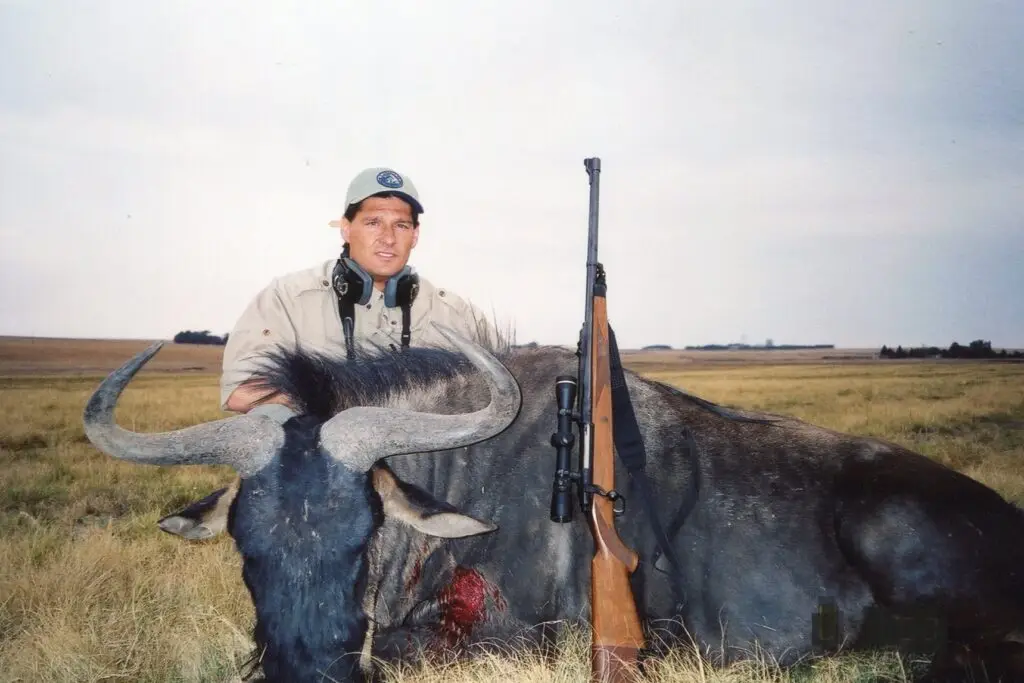
Physically, the blue wildebeest is heavily built, featuring a disproportionately large, boxy head and broad shoulders that slope down to slimmer, spindly legs. Both males and females grow dark, curved horns similar to those of a female African buffalo. The name “blue” comes from the shimmering, slate-grey to bluish-silver sheen of their coat, which is vertically marked by dark “brindled” stripes along the forequarters. Adult males are generally larger and darker than females, with full, robust bodies that can weigh up to 600 pounds.
Behaviorally, they are highly social and are renowned for forming massive, nomadic herds. In the famous Serengeti-Mara ecosystem, this herding behavior culminates in the spectacular “Great Migration,” where hundreds of thousands of wildebeest traverse hundreds of miles annually in search of fresh grazing lands and water. They are vocal, noisy, and active grazers, equipped with broad muzzles designed to quickly bulk-feed on short grasses, often working in tandem with zebras that graze the taller vegetation first.
Because they are a prime food source for formidable predators like lions, cheetahs, hyenas, and crocodiles, their survival relies heavily on sheer numbers and synchronized reproduction. Up to 90% of wildebeest calves are born within a brief two to three-week window, creating a massive influx that overwhelms local predators. Adding to this survival adaptation, newborn calves are born to run; they can stand within minutes of birth and are capable of galloping alongside the herd in less than two hours.
Description of the Blue Wildebeest
- Coat & Markings: Short hair ranging from deep slate grey to light grey or grayish-brown. The flanks and shoulders are marked with faint, dark vertical stripes (giving it the nickname “brindled gnu”). Young calves are born tawny brown.
- Head & Face: Features a wide, robust muzzle with a black face and forehead. A long, flowing mane runs down the back of the neck, and a dense beard (usually white or black depending on the subspecies) hangs from the throat.
- Horns: Both males and females possess horns that curve outwards from a thick base on the forehead, then hook upwards and inwards. Adult male horns are thicker, darker, and joined at the base by a heavy, protective structure called a “boss”.
- Tail: Features a long, dark or black tail resembling that of a horse, measuring from 24 to 39 inches.
- Shoulder Height: from 3.9 to 4.7 feet.
- Head and Body Length: from 5 to 7.75 feet.
- Weight: Adult females weigh from 260 to 570 pounds, while males can reach from 550 to 640 pounds.
Recommended Calibers
Use a minimum of a .30 caliber rifle to hunt wildebeest.
Where to Hunt Blue Wildebeest
Free range hunts are conducted in South Africa, Namibia, Zimbabwe, and Botswana.
High fence hunting preserves in Texas and Oklahoma offer blue wildebeest hunts.
What is Considered a Trophy Blue Wildebeest
A mature trophy blue wildebeest will have horns measuring from 24 to 27 inches long. Look for the horn tips to be at least an inch outside the ears on each side.
Cost to Hunt Blue Wildebeest
A standard colored blue wildebeest trophy fee is from $1,200 to $2,500 in Africa. Color variant (golden, kings, royal, etc.) blue wildebeests usually cost from $2,000 to $10,000.
In the USA, blue wildebeest hunts cost from $6,000 to $12,000.
View Our Hunts