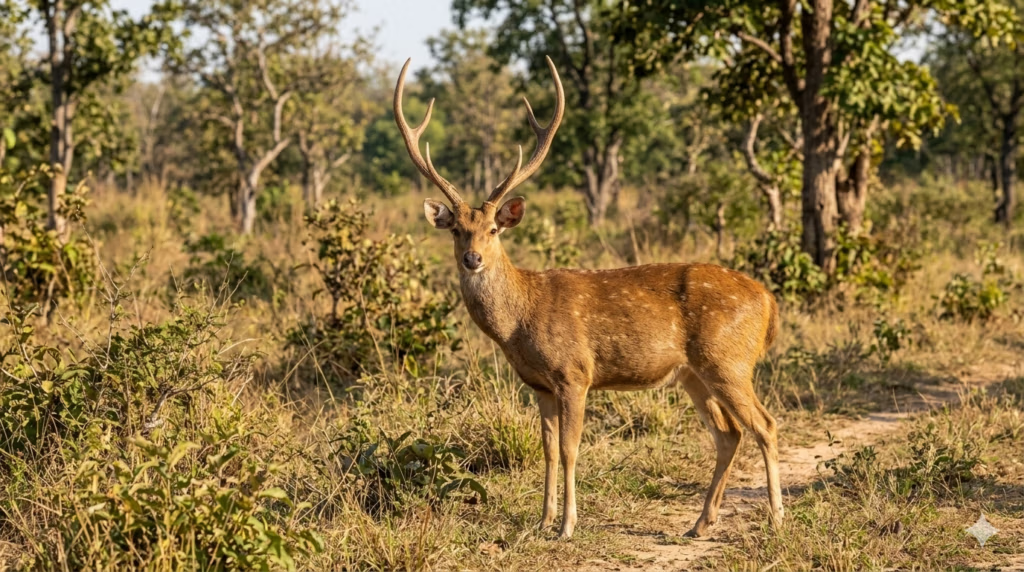

About the Elds Deer
Info About the Elds Deer
The Eld’s deer is a rare, endangered species native to South and Southeast Asia, easily recognized by its unusually shaped antlers and preference for dry, open forests. Also widely known as the thamin or brow-antlered deer, this unique ungulate faces severe threats in the wild but remains a major focus of international conservation efforts.
Eld’s deer boast several distinct physical and behavioral traits, most notably their incredible antlers, which can grow up to 40 inches long. Unlike most deer, the lower beam of the male’s antlers curves backward and then sweeps forward, taking on a shape reminiscent of a musical lyre. Because of this unique curvature, the lowest points appear to grow right from the eyebrows, earning them the name “brow-antlered deer”. Males are generally larger than females, often reaching weights up to 385 pounds. Their coats are rough and coarse, transitioning from reddish-brown in the summer to dark brown in the winter months.
These deer primarily inhabit dry, open deciduous forests, lowland valleys, and marshy environments. Depending on the specific geographic region, the species is split into three recognized subspecies: the Manipuri brow-antlered deer in India, the Burmese thamin, and the Siamese Eld’s deer. They are typically active during the evening and night, resting in the shade during the hot daytime hours to ruminate and digest their herbivorous meals. Their diet consists of various wild grasses, herbaceous plants, and fallen fruits; however, they frequently venture into nearby farmlands to graze on cultivated crops like rice, lentils, and maize, which often brings them into conflict with local farmers.
Currently, all subspecies of the Eld’s deer are classified as endangered. Wild populations have suffered devastating declines over the past few decades, driven primarily by rampant deforestation, agricultural expansion, and heavy poaching for their meat and impressive antlers. With fewer than 1,500 to 2,500 individuals estimated to remain in the wild, survival now heavily relies on managed captive breeding programs. Conservation organizations and global zoos are actively studying their genetics and reintroducing captive-born populations back into protected reserves in Thailand and Cambodia to ensure the species avoids total extinction.
Description of the Elds Deer
Physical Specifications
- Height & Length: Stand from 45 to 48 inches at the shoulders. Body length ranges from 59 to 71 inches long.
- Weight: Weigh from 154 to 386 pounds, with males consistently larger and heavier than females.
- Coat: Rough, coarse hair that undergoes seasonal color changes. Summer coats are reddish-fawn to reddish-brown, while winter coats become a dark, grayish-brown.
- Antlers: Distinct bow or lyre-shaped antlers that curve in one continuous arc, growing up to 39 inches long. The brow tine extends directly forward to form a seamless curve.
Elds Deer Species / Subspecies
Manipuri Brow-Antlered Deer:
- Location: Endemic to the Keibul Lamjao National Park in Manipur, India.
- Local Name: Known as the Sangai in Meitei.
- Distinction: Known for its unique, dancing-like gait in its swampy wetland habitat.
Burmese Brow-Antlered Deer:
- Location: Distributed across Myanmar and western Thailand.
- Local Name: Commonly referred to as the Thamin.
- Distinction: Features a slightly curved brow tine and is physically the most robust of the three subspecies.
Thai Brow-Antlered Deer:
- Location: Found in Cambodia, China, Laos, Thailand, Vietnam, and the island of Hainan.
- Distinction: Possesses a continuous, circular beam structure in its antlers; some genetic researchers advocate that it should be classified as a distinct species.
Recommended Calibers
Use a minimum of a 6.5mm caliber rifle to hunt Elds deer.
Where to Hunt Elds Deer
Elds Deer hunting is only conducted on private game ranches in Texas.
What is Considered a Trophy Elds Deer
Eld’s deer trophy size features main antler beams measuring from 30 to 39 inches in length.
Cost to Hunt Elds Deer
It costs from $11,000 to $15,000 to hunt Elds deer.
View Our Hunts