
About the Tur
Info About the Tur
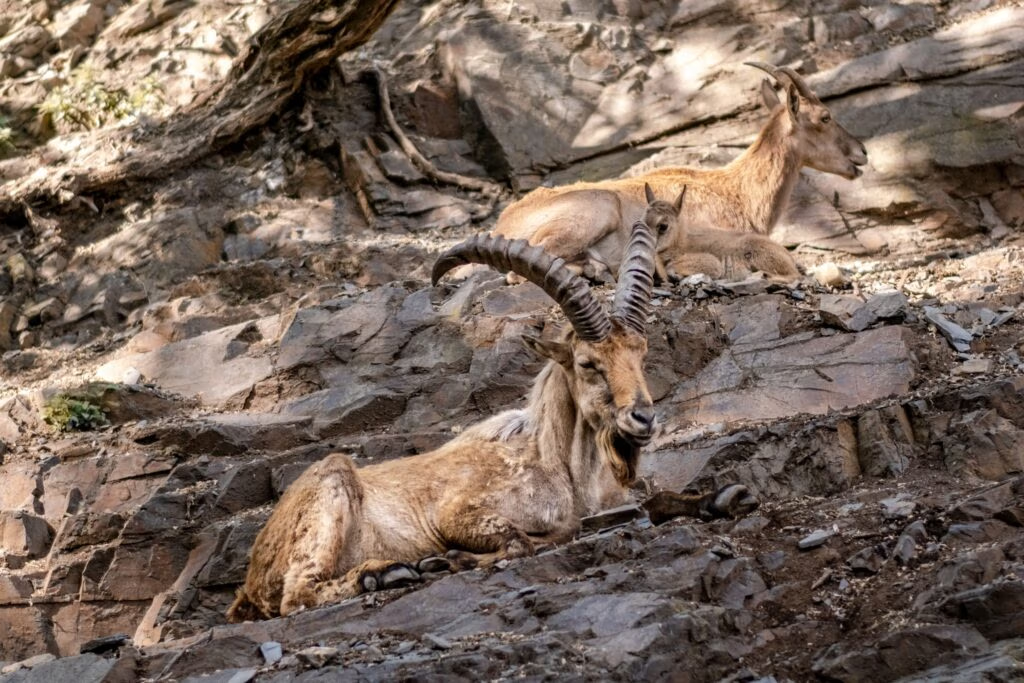
The tur is a rare, mountain-dwelling species of wild goat native exclusively to the rugged, remote terrain of the Caucasus Mountains. Masters of navigating steep cliffs and thin air, turs are divided into two main species: the West Caucasian tur and the East Caucasian (Dagestan) tur. They are highly resilient herbivores, uniquely adapted to surviving freezing winters and harsh alpine environments.
Physically, the tur looks like a strong, muscular blend of a wild goat and an ibex. Males are particularly striking, boasting massive, heavily ridged horns that sweep backward. Females are significantly smaller with much shorter horns. Their coats change with the seasons to provide optimal camouflage; in the summer, they wear a sleek, reddish-brown coat that deepens to a dark or grayish-brown in the winter, blending perfectly with the rocky, snow-dusted peaks.
Turs lead fascinating social lives that revolve around seasonal, vertical migrations up and down the mountain slopes. For most of the year, males and females live in strictly separated single-sex herds. However, during the late-fall mating season (the rut), the herds mix as they descend to lower elevations to escape heavy snow, with males fighting aggressively for mating rights. Today, both species face conservation concerns due to competition with livestock, harsh weather, and human hunting, though significant portions of their population now reside in protected reserves.
Description of the Tur
Body Size
- Sexually Dimorphic: Males are about 30% larger and twice as heavy as females.
- Shoulder Height: from 31 to 43 inches tall for males; from 31 to 33 inches tall for females.
- Body Length: from 47 to 65 inches long.
- Weight: from 143 to 250 pounds for males; from 110 to 132 pounds for females.
Coat and Color
- Summer Coat: Rusty-gray to rufous-brown with darker legs and a lighter, yellowish-tan underbelly.
- Winter Coat: Coarser and duller, turning greyish-brown, with adult male East Caucasian turs adopting a solid dark-brown coat.
- Facial Markings: Short and blunt face. The Eastern Tur often has a dark dorsal stripe running down its spine.
Both sexes have horns, but they vary heavily by species (Western vs. Eastern) and sex.
- Western Caucasian Tur: Features heavy, scimitar-shaped horns. Males average from 28 to 30 inches in length, while females have shorter horns measuring roughly 8 inches long.
- Eastern (Dagestan) Caucasian Tur: Bears heavy, cylindrical horns that curve backward and inward, resembling a blue sheep. Male horns span from 28 to 35 inches long.
Beards
- Males: Develop a narrow, prominent beard that grows up to 7 inches long. It is stiff and projects forward in Eastern turs.
- Females: Beards are small or entirely absent.
Recommended Calibers
Use a minimum of a long-range .30 caliber magnum rifle to hunt Tur.
Where to Hunt Tur
Free range Tur hunting is done in Russia and Azerbaijan.
High fence hunting preserves in Texas offer tur hunts.
What is Considered a Trophy Tur
Horns measuring at least 31 inches long are a trophy tur.
Cost to Hunt Tur
In Europe and Asia, it costs from $6,000 to $14,000 to hunt tur.
In Texas, it costs $18,000 or more to hunt tur. These are usually Western Caucasian Tur.
View Our Hunts