
About the Thomson’s Gazelle
Info About the Thomson's Gazelle
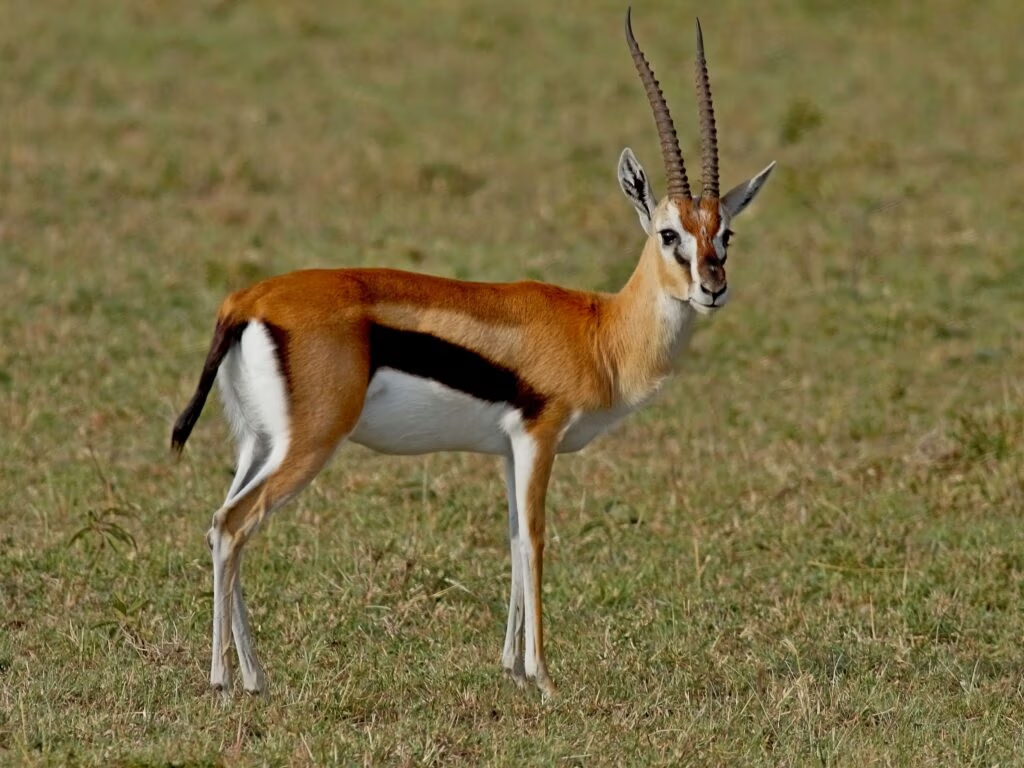
The Thomson’s gazelle, affectionately known as the “Tommy,” is one of the most recognizable and common antelopes of the East African savanna. Named after the 19th-century Scottish explorer Joseph Thomson, this slender herbivore is immediately identifiable by its distinct sandy-brown coat, bright white belly, and a stark black stripe separating the two. Both males and females feature striking, backward-curving horns, though the males’ are noticeably longer and thicker.
These highly social animals roam the shortgrass plains of Kenya and Tanzania in fluid herds that can range from a few dozen to several thousand individuals, depending on the season. They are perfectly adapted to their arid environment, capable of obtaining nearly all their required hydration from the lush plant matter and dew they consume. They often trail larger migratory herds, like zebras and wildebeests, taking advantage of the shorter, fresh grasses revealed after the bigger animals have passed through.
Living on the open, exposed plains means the “Tommy” is a primary food source for major savanna predators, including lions, leopards, hyenas, and cheetahs. To survive, they rely on exceptional speed and agility, capable of sprinting up to 50 mph while performing sharp, zigzag movements to throw off pursuers. They also engage in a unique, high-jumping behavior known as pronking. By leaping straight into the air with stiff legs, they not only alert the herd of danger but also show predators that they are too strong and fast to be worth the chase.
Description of the Thomson’s Gazelle
The Thomson’s gazelle is a small, slender East African antelope with a tan to reddish-brown back, a stark white belly, and a distinctive horizontal black stripe running down its sides. It features a prominently white rump and a long black tail. Both sexes have horns, though males’ are larger and heavily ridged.
Key physical characteristics of the Thomson’s gazelle include:
- Height: Stands from 21 to 32 inches tall at the shoulders.
- Weight: Ranges from 25 to 77 pounds, with males generally being larger and heavier than females.
- Distinctive Markings: A bold, dark band separates their upper coat from their brilliant white underbelly. Their faces are reddish-brown, accented by white rings around the eyes, dark tear-stripes running from the inner eye corners to the nose, and a light-colored forehead.
- Horns: Males possess heavily ridged horns that curve backward and measure from 10 to 17 inches in length. Females have much smaller, smoother, and sometimes deformed horns, and in some cases, lack horns entirely.
- Tail: A completely black, twitching tail that measures from 6 to 10.5 inches in length.
Thomson’s Gazelle Species / Subspecies
Serengeti Thomson’s gazelle
- Range: Found in the Serengeti plains extending into the Kenya Rift Valley.
- Characteristics: Typically darker in color with a more pronounced dark band on the nose.
Eastern Thomson’s gazelle
- Range: Located east of the Rift Valley in Kenya and Tanzania, extending south to Arusha and the Shinyanga region.
- Characteristics: Generally lighter in coloration and slightly smaller than the Serengeti subspecies.
Recommended Calibers
Hunting Thomson’s gazelle requires a flat-shooting, long-range rifle to navigate wide-open plains. Ideal calibers include the .300 Winchester Magnum, .270 Winchester, .30-06 Springfield, or the 7mm Rem Mag.
Where to Hunt Thomson's Gazelle
Thomson’s Gazelles are hunted free-range in Tanzania.
They can be hunted on high-fence hunting preserves in Texas.
What is Considered a Trophy Thomson's Gazelle
A Thomson’s Gazelle with horns measuring 10 inches or more is a trophy animal.
Cost to Hunt Thomson's Gazelle
It costs from $6,500 to $20,000 to hunt Thomson’s gazelle depending on the country you choose. A Texas hunting preserve can be cheaper to hunt than Africa because of the high daily fees charged by countries such Tanzania.
View Our Hunts