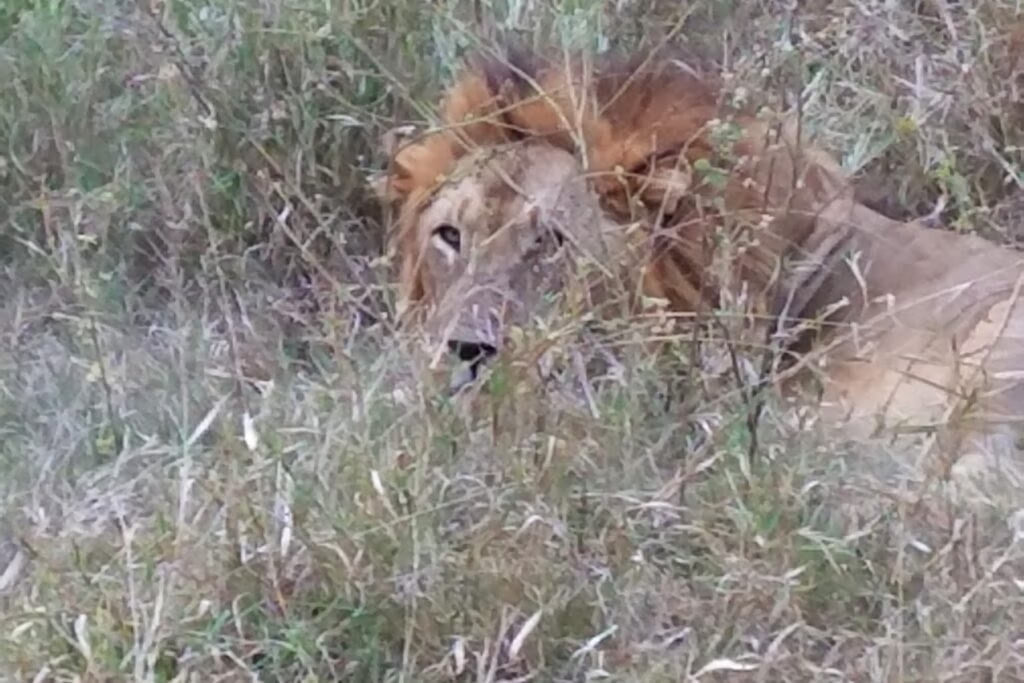

About the Lion
Info About the Lion
The lion is a powerful, highly social apex predator known historically as the “king of the jungle”. Once found across much of Europe, Asia, and Africa, wild lions are now primarily restricted to sub-Saharan Africa.
Unlike most other solitary felines, lions are remarkably social, living in family groups called prides. A typical pride consists of related females, their offspring, and a small coalition of dominant males. The lionesses are responsible for the majority of the hunting, using cooperative strategies to stalk and capture prey, while the males focus on defending the pride’s territory.
Physically, lions display distinct sexual dimorphism. They are built for strength rather than endurance, capable of reaching speeds up to 50 mph over short distances. Famous for their deafening roars, which can reach 114 decibels and be heard up to 5 miles away, lions use their vocalizations to communicate across vast distances and mark their turf.
Description of the Lion
Key Physical Features
- Body and Size: Lions stand from 40 to 48 inches tall at the shoulders and reach body lengths between 64 and 98 inches long.
- The Mane: The defining characteristic of the male lion. Ranging in color from blonde to reddish-brown and black, it covers the head, neck, and shoulders. It acts as a shield during fights and signals health and dominance to females.
- Coloration: Coat colors range from sandy, buff yellow, and orange-brown to silvery gray. Their underbellies and inside legs are typically white. Cubs are born with dark rosette spots that usually fade as they mature.
- Tails: The lion’s tail is from 24 to 36 inches long and ends with a distinctive dark, hairy tuft, which is unique among big cats.
Adaptations
- Limbs and Paws: They have incredibly muscular forelimbs and shoulders adapted for stalking, grabbing, and wrestling large prey to the ground. Their paws house sharp, fully retractable claws.
- Senses: Lions have exceptional night vision, long white sensory whiskers, and a specialized white circle below the eyes to help reflect light in the dark.
- Jaws: They have large skulls with sharp canine teeth up to nearly 2 inches in length.
Recommended Calibers
As a member of the Big 5, the .375 is the minimum caliber used to hunt lions.
Where to Hunt Lion
Lions can legally be hunted in Tanzania, Mozambique, and Zimbabwe. There are occasionally lion tags available in Zambia, Namibia, Botswana, and Cameroon. South Africa has discontinued their lion hunting.
The rules and regulations are generally in a state of flux for hunting and importing lions into North America, so it’s best to know the current laws before attempting to hunt them.