
About the Bushbuck
Info About the Bushbuck
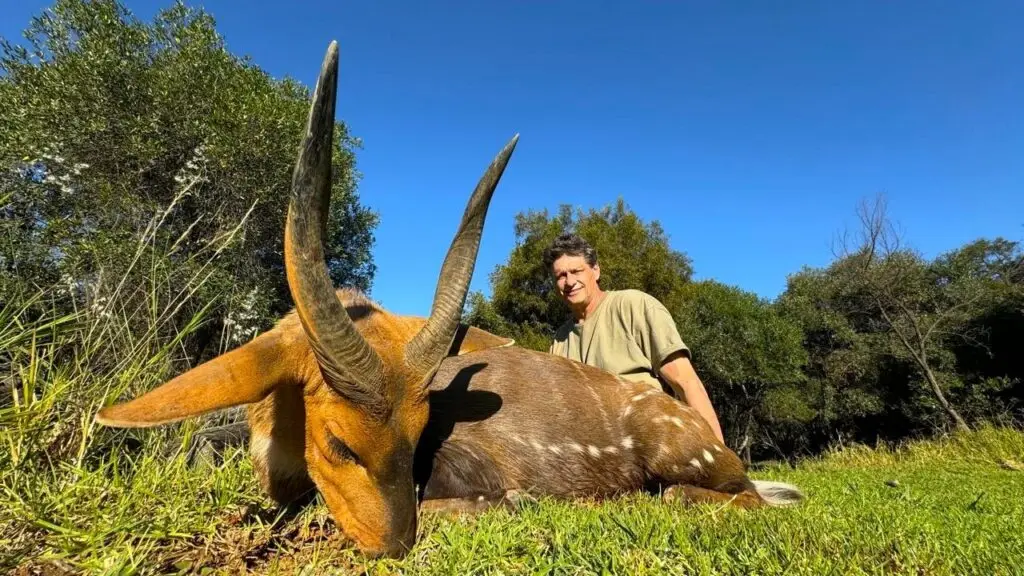
The bushbuck is a highly adaptable, medium-sized African antelope. Known for their shy nature, these herbivores are widespread across sub-Saharan Africa, inhabiting dense brush, rainforests, and forest edges. They are easily identified by their striking, camouflaged coats, which range from chestnut to dark brown and feature varying white stripes and spots.
These solitary antelopes possess a unique social structure as they are largely non-territorial. Adult males actively avoid one another, and individuals do not defend their home ranges. Instead of running from danger, their first line of defense is concealment—they will often freeze or lie completely flat on the ground to blend into the shadows. When cornered or threatened, they emit a surprisingly loud, hoarse bark to warn off predators.
Bushbucks are primarily browsers rather than grazers, feeding on leaves, shrubs, and fallen fruit. They are remarkably self-sufficient when it comes to hydration, often extracting the majority of their required moisture directly from the dew on the leaves they eat. While they are one of the most widespread antelope species with stable populations exceeding 1.3 million, their reliance on brush means they remain vulnerable to habitat fragmentation and human agricultural expansion.
Description of the Bushbuck
Size
- Height: Stand from 25 to 39 inches at the shoulder.
- Weight:
- Females: from 55 to 130 pounds.
- Males: from 90 to 176 pounds.
Horns (Males only)
- Present on males only, developing when the animal reaches about 10 months of age.
- Average length from 10 to 22 inches.
- They grow relatively straight and feature a distinct single spiral twist.
Coat and Markings
- Coloration: Varies by geographic subspecies. Northern/Western varieties are reddish-brown, while Southern/Eastern variants range from yellowish-brown to dark grayish-brown.
- Stripes and Spots: Both sexes have geometrically shaped white spots and up to 7 vertical white stripes along their flanks.
Bushbuck Species / Subspecies
Recent genetic and taxonomic studies split the bushbuck into two distinct species, rather than a single widespread species.
Kéwel
Better known as the Western Bushbuck or Harnessed Bushbuck.
- Distribution: Northern and western Africa, stretching from Senegal to Ethiopia.
- Appearance: Tends to be brighter, chestnut-to-reddish coat with bold, white “harness” stripes and spots.
- Subspecies: Considered mostly monotypic (regional variations exist but are not widely accepted as distinct subspecies).
Imbabala
Better known as the Southern Bushbuck, Cape Bushbuck, or Imbabala.
- Distribution: Eastern and southern Africa, from Ethiopia down to South Africa.
- Appearance: Darker brown coat with fainter, broken white stripes and spots.
- Recognized Subspecies:
- Cape Bushbuck – Found in the southernmost regions of South Africa.
- Chobe Bushbuck – Brighter coat with numerous white spots, found along rivers and floodplains (e.g., the Zambezi / Chobe).
- Limpopo Bushbuck – Slightly larger than the Cape Bushbuck.
- Menelik’s Bushbuck – Almost black in color, adapted to high-altitude Ethiopian mountains.
- East African Bushbuck – Found along the eastern coast and riverine woodlands.
Recommended Calibers
Use a minimum of a .243 caliber rifle to hunt bushbuck.
Where to Hunt Bushbuck
Bushbucks are primarily hunted in sub-Saharan Africa, with the most popular and accessible destinations being South Africa, Zambia, Zimbabwe, and Cameroon. Because they are elusive and prefer dense, brushy, or riverine habitats, they require spot-and-stalk or walk-and-stalk hunting styles.
Key destinations and subspecies to consider for a hunt:
- South Africa (Cape & Limpopo Bushbuck): The premier destination for bushbuck. The Eastern Cape and KwaZulu-Natal are renowned for the Cape Bushbuck, while the Limpopo Province is famous for the larger Limpopo Bushbuck.
- Zambia & Zimbabwe (Chobe Bushbuck): These can be found along the river systems and floodplains of the Zambezi and Luangwa rivers.
- Cameroon, CAR, and Benin (Harnessed Bushbuck): Excellent locations for hunting the Harnessed Bushbuck, which is typically found in thicker riverine growth and savannas in Central and West Africa
What is Considered a Trophy Bushbuck
A mature bushbuck typically has horns measuring from 12 to 13 inches. A bushbuck with 15 inch horns or longer is an exceptional trophy.
Cost to Hunt Bushbuck
A trophy fee for a bushbuck is from $800 to $2,000.
View Our Hunts