
Wildebeests, also known as gnus, are large, gregarious antelopes native to the savannas and open woodlands of eastern and southern Africa. Belonging to the bovid family, they possess a highly distinctive, almost patchwork appearance featuring a heavy, boxy head like a cow, the slender legs of a gazelle, and a shaggy mane.
These herbivores are famous for participating in the Great Migration, one of the largest overland animal migrations on Earth. Driven by seasonal rainfall patterns, herds numbering upwards of 1.5 million wildebeests embark on a perilous, continuous loop to find fresh grazing pastures, often navigating crocodile-infested rivers along the way.
Description of the Wildebeest
Wildebeests stand 3.8 to 4.8 feet tall at the shoulders.
They weigh between 260 and 594 lbs.
Both sexes have curved horns.
Wildebeest Species / Subspecies
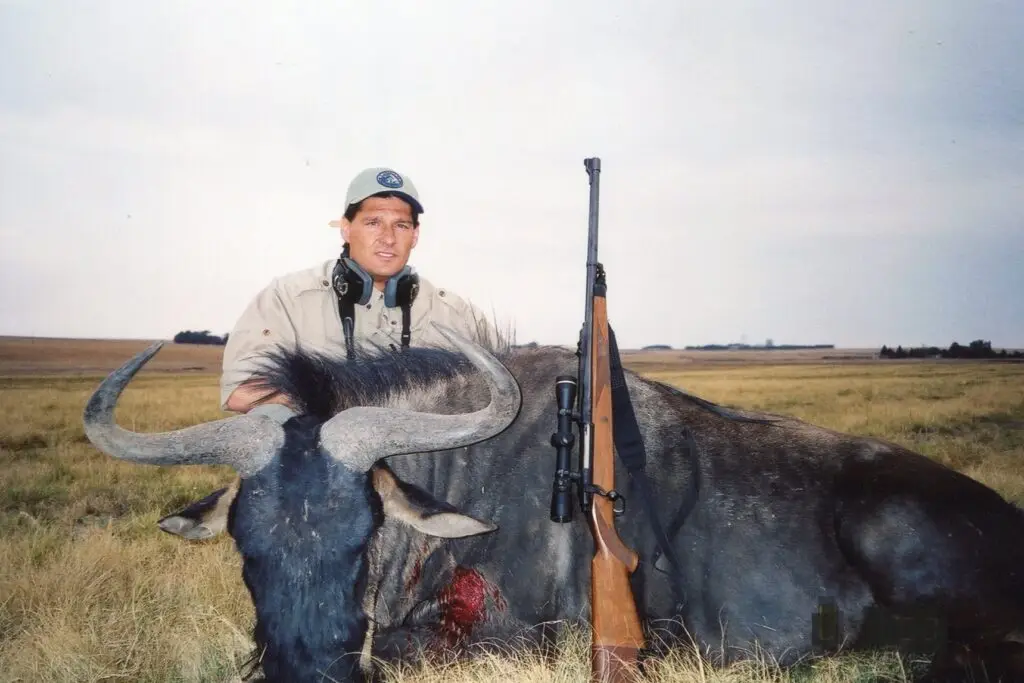
- Blue Wildebeest: Larger than the black wildebeest. They feature a slate-gray to dark brown coat with faint dark vertical stripes on their forequarters. Their sweeping horns protrude to the side, curve downward, and then upward back toward the skull.
The blue wildebeest comes in several subspecies and color phases / variants.
- Blue – The most common.
- Golden – light tan/gold color variation of the blue wildebeest.
- Nyasa – The Nyasa wildebeest, also known as the Niassa or Johnston’s wildebeest, is a smaller, brownish-gray subspecies of the blue wildebeest. It is most distinctively identified by a prominent, bright white band running across the bridge of its muzzle, though some individuals may lack this feature. The Nyasa lives in Mozambique, Tanzania, and parts of Malawi.
- Kings – a blue wildebeest that has tan/gold/yellow colored hair in various parts of it’s body such as; face, beard, mane, and tail.
- Western White-bearded Wildebeest – The darkest and smallest blue wildebeest subspecies. The Western White-bearded lives in Kenya and Northern Tanzania.
- Eastern White-bearded Wildebeest – Slightly lighter in color than its western relative, featuring a distinctively creamy-white beard. The Eastern White-bearded live in Kenya and Northern Tanzania.
- Cookson’s Wildebeest – Notable for its lighter coloring, larger body, and significantly larger horns. The Cookson’s lives in the Luangwa Valley in Zambia.
- Black Wildebeest: Smaller and stockier with a dark brown to black coat and an eye-catching, long white tail. Their horns project forward and downward before curving sharply upward at the tips.