About the Bison
Info About the Bison
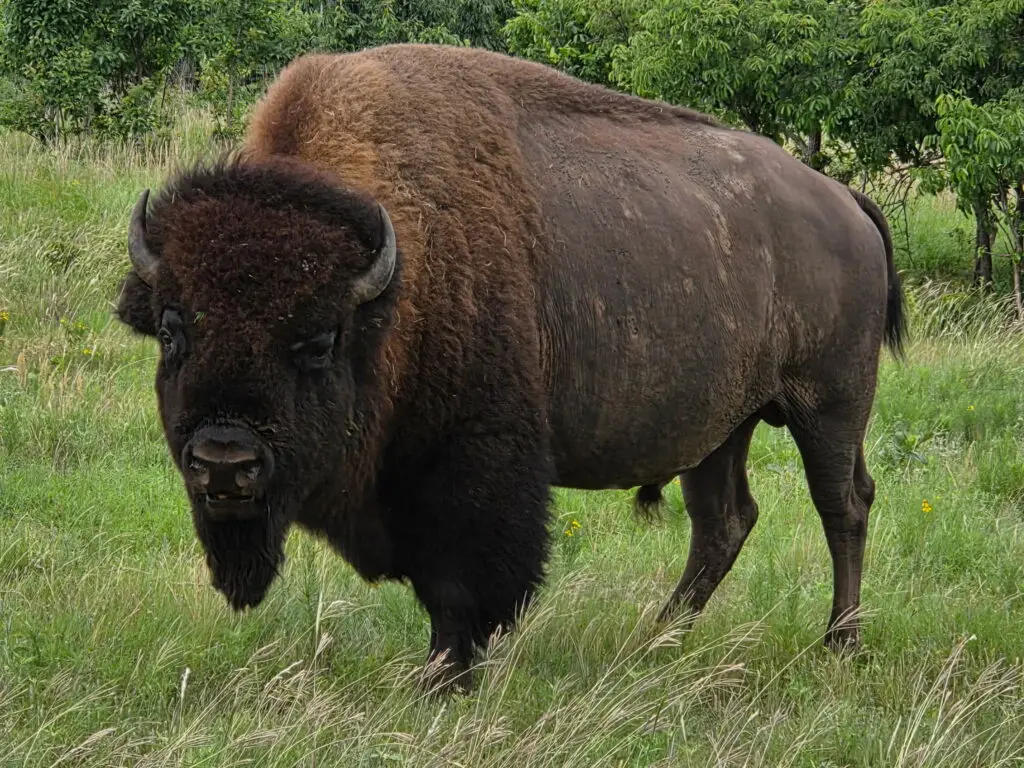
The American bison is the largest land mammal in North America. Often mistakenly called “buffalo”, these magnificent herbivores are instantly recognizable by their massive, shaggy-coated heads, protruding shoulder humps, and curved horns. Bulls are massive and muscular, yet they are remarkably agile and capable of sprinting up to 35 miles per hour.
Historically, an estimated 30 to 60 million bison roamed the Great Plains, where they acted as a keystone species. Their grazing patterns and trampling shaped the prairie ecosystem, while their dust-bathing—known as “wallowing”—created small depressions that provided vital microhabitats for insects and amphibians. For thousands of years, these enormous herds were deeply intertwined with the cultures and survival of Indigenous Plains tribes. However, by the late 19th century, overhunting had driven the species to the brink of extinction, reducing their numbers to fewer than 1,000 animals.
Today, thanks to dedicated conservation initiatives, the American bison has made an incredible comeback. They were named the national mammal of the United States in 2016. While many are managed for commercial production, thousands now roam freely in protected conservation herds located in national parks, wildlife refuges, and tribal lands across North America.
Physical Appearance of the Bison
- Size and Weight: Adult males (bulls) are massive, standing from 5.5 to 6.5 feet tall at the shoulder and weighing from 1,400 to 2,200 pounds. Females (cows) are smaller, typically weighing from 700 to 1,000 pounds.
- Shoulder Hump: Their most defining physical feature is a high, muscular hump above the front shoulders. This hump is packed with massive muscles that allow the bison to use its head as a powerful snowplow during brutal winters.
- Coat: They possess a thick, shaggy coat of dark brown or black fur that is particularly dense around the head, neck, and forelegs, often forming a distinct “beard” under the chin. They shed this heavy coat in large patches during the spring.
- Horns: Both males and females grow a single pair of sharp, black, upward-curving horns that can reach up to 2 feet in length. Unlike deer antlers, bison horns are permanent and are never shed.
Recommended Calibers
The best cartridges for bison hunting are those that offer deep penetration and high energy retention, typically .30-caliber (7.62mm) or larger, with premium, controlled-expansion bullets. Given the massive size and thick hide of bison, especially bulls, cartridges that produce at least 2,800 foot pounds of energy at the muzzle are often considered minimum for an ethical harvest, with many hunters preferring heavy, hard-cast bullets.
Where to Hunt Bison
Hunting the American bison is a pursuit steeped in history and demanding a deep respect for an iconic plains animal. The hunt is typically a spot-and-stalk style approach. Because adult bison have few natural predators, they are often unbothered by humans, allowing hunters to close in carefully before taking a shot.
Hunts take place on sprawling private ranches or via tightly regulated public tag draws.
US Public Land Lottery Draws
Securing a wild, free-ranging public tag is a once-in-a-lifetime event. Because populations are strictly managed for conservation, draw odds are incredibly low–often under 1% to 2%.
- Wyoming: Features the famous Jackson Bison Herd. Successful draw applicants hunt the rugged fringes surrounding Grand Teton National Park and the Bridger-Teton National Forest, often using mountain horses to pack out the massive meat harvest.
- Utah: Known for its wild, free-ranging herds in the remote Henry Mountains and Book Cliffs regions.
- Montana: Governed by Montana FWP, these hunts occur primarily along the boundaries of Yellowstone National Park (such as the West Yellowstone basin) when bison migrate out of the park during heavy winters.
- Alaska: A highly prized, remote backcountry hunt for the massive woodland bison subspecies. This hunt takes place in the dense, freezing northern river valleys.
- Arizona: Offers a unique desert-mountain hunting environment via strict state lottery draws
Private Ranches and Managed Estates (Guaranteed Tags)
If you do not want to wait decades to draw a public permit, private ranches allow you to buy a guaranteed harvest tag over the counter. Many of these of ranches offer multi-day guided hunting packages for trophy bison or for meat.
- South Dakota and North Dakota: Offer fully-guided ranch hunts.
- Oklahoma and Texas: Private game ranches that offer multi-day guided hunting packages with accommodations and meals included.
Canada
- Canadian hunts provide incredible wilderness expeditions primarily targeting the larger woodland bison subspecies.
What is Considered a Trophy Bison
A good bison (American buffalo) trophy is typically evaluated by horn size, hide quality, and the animal’s maturity. Because mature bulls feature immense heads, massive shoulder humps, and long, dense coats, a prime trophy requires striking a balance between impressive skull dimensions and beautiful winter hair.
Key Trophy Characteristics
- Age and Maturity: Hunters typically target mature, older bulls that are usually 6+ years old and have developed thick manes, dark chocolate coats, and broad chests.
- Hide and Beard: A premium trophy features long, dense hair around the head, neck, and forelegs.
- Horns: The horns are the defining metric for an officially recognized trophy
- Base Circumference: A thick base is a major indicator of a top-tier bull. Good trophies typically have bases of 15 inches or wider.
- Horn Length: An excellent bull will have horn lengths measuring between 18 and 20 inches from base to tip.
- Tip to Tip Spread: A desirable spread across the widest points of the horns generally reaches 30 to 35 inches.
Cost to Hunt Bison
Public Land Lottery Draw Hunt Cost
- Average cost is from $1,000 to $4,500.
- The price covers non-resident state license fees, tags, and personal gear.
Ranch Meat Hunt Cost
- Average cost is from $3,500 to $5,500.
- These are non-trophy animals hunted for hundreds of pounds of lean meat.
Trophy Bull Ranch Hunt Cost
- Average cost is from $5,000 to $13,000+.
- Price depends on the horn size, age of the bull, and cape quality.
Canada Wilderness Hunts
- Average Cost is from $10,000 to $15,000+.
- Usually booked as a 6 to 9 day free-range wilderness hunt that is fully guided.
View Our Hunts