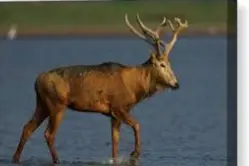

About the Pere David’s Deer
General Information
The Père David’s deer is a uniquely adapted Asian species known as the “milu” in its native China. Easily recognized by their unmistakable features—the neck of a camel, hooves of a cow, tail of a donkey, and antlers of a deer—these large animals are highly specialized for marshy, wet environments. Unlike most other deer species, they possess wide, splayed hooves and are strong swimmers capable of spending hours immersed in water to feed on aquatic plants.
Fortunately, a few dozen deer had been secretly acquired by European diplomats and missionaries in the 19th century. The 11th Duke of Bedford gathered the remaining European survivors—a mere 18 individuals—and established a thriving, carefully managed breeding herd at his Woburn Abbey estate in England. Today, thanks to that isolated herd, the global population has rebounded into the thousands. Through dedicated reintroduction programs that began in the 1980s, hundreds of these magnificent deer once again roam freely in nature reserves across China.
Description of the Pere David’s Deer
- Size: They are large, stocky deer, standing about approximately 4 feet tall at the shoulder.
- Weight: Adults typically weigh between 297–440 lbs., with males often larger than females.
- Length: The total head-to-body length is up to 6 to 7.5 feet long.
- Head and Neck: They have a long, slender head with a naked nose pad, large eyes, and very small, pointed ears. Males often have a mane on their neck and throat.
- Antlers: The male’s antlers are distinctive and “reversed” compared to other deer, with a long main beam extending upwards and a long fork pointing backward. They are unique in that they can grow two sets of antlers in a single year.
- Coat: The coat is reddish-tan or reddish-brown in the summer and turns to a dull grey or grayish-brown in the winter. A dark dorsal stripe runs along the spine.
- Tail: They possess an unusually long tail for a deer of 12 to 26 inches—ending in a dark, thick tuft or tassel.
- Hooves: They have large, wide, and spreading hooves that make a clicking sound when walking, which are adapted for navigating marshy, soft wetlands.
Suitable Weapons
A 7mm or larger cartridge is a good choice for the Pere David’s Deer.
Hunting Area
Pere David’s deer are extinct in the wild, so you cannot hunt them in a native, free-range environment. However, you can hunt them year-round on private exotic ranches, game estates, and conservation preserves in locations like Texas, Argentina, England, and New Zealand.